ACH Payment Integration Services: Plaid, Dwolla, Stripe, and Finix Options for US FinTech Platforms

Updated: Aug 19
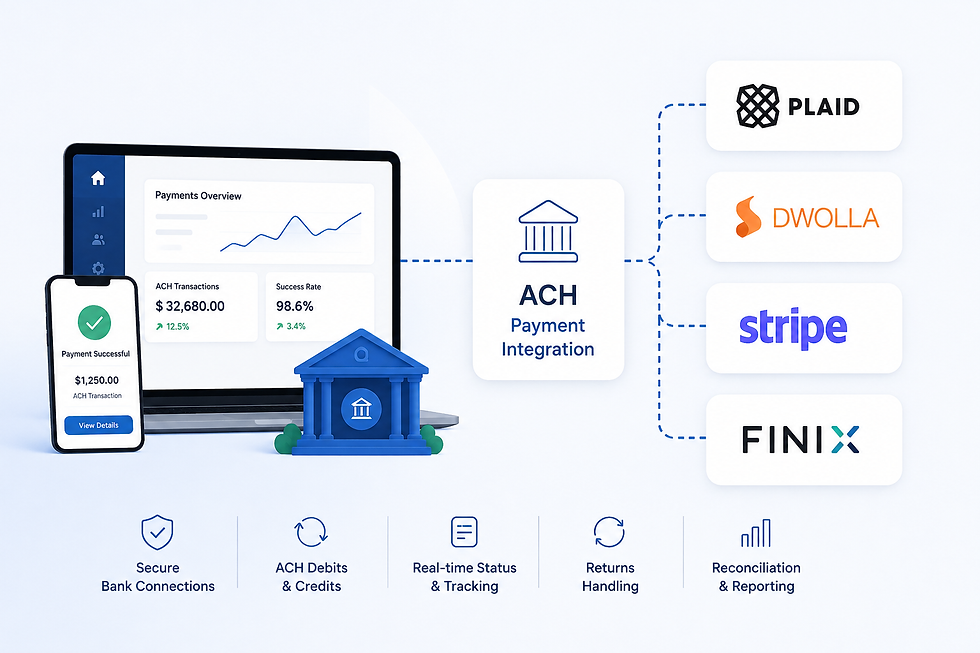
The wrong ACH provider rarely fails. It becomes expensive when returns increase, reconciliation becomes manual, or a platform needs a funds flow its architecture cannot support.
For US FinTech companies, ACH payment integration is therefore a product and operations decision, not simply an API task. The provider influences how users connect bank accounts, how quickly payments are confirmed, who carries return risk, how support teams investigate failures, and whether the platform can later add payouts or faster rails.
Plaid, Dwolla, Stripe, and Finix all support bank-payment use cases, but they enter the stack from different directions.
What Are ACH Payment Integration Services?
ACH payment integration services connect a product to the US Automated Clearing House network through a payment provider. Depending on the use case, the integration may let customers verify a bank account, authorize a debit, fund an account, repay a loan, receive a payout, or pay a recurring invoice.
The work is broader than adding a “Pay by bank” button. Production scope can include onboarding, bank verification, authorization, debits, payouts, webhooks, ledger updates, returns, reconciliation, audit logs, and support tools.
ACH is asynchronous and returnable. An API may accept a payment request while the transaction is still pending at the bank. A reliable system must represent that uncertainty instead of treating the first successful response as final funds.
How ACH Payment Integration Works in a US FinTech Platform
1. Verify the user and connect a US bank account
Determine whether the user is an individual, business, merchant, seller, or recipient. KYC/KYB duties vary by program. Users may connect instantly or enter bank details for another verification method. A valid account is not automatically a low-risk payment.
3. Capture ACH authorization
For a debit, preserve the authorization text, payment terms, date, user identity, and audit details. Recurring payments need a revocation process and appropriate legal review.
4. Create the debit, credit, or payout
A pay-in pulls money from a customer; a payout pushes money to a recipient. Marketplace flows may also involve sellers, fees, settlement accounts, and reserves.
5. Process webhooks and reconcile funds
Handle pending, failed, returned, and settled events with verified webhooks, idempotency, and retries. Map every provider transaction to the internal ledger.
Questions to Answer Before Choosing an ACH API Integration
Before comparing product pages, map the actual funds flow:
Do you need verification, money movement, or both?
Are payments inbound, outbound, or bidirectional?
Are you a merchant, lender, SaaS platform, wallet, or marketplace?
Who absorbs returns, fraud losses, and negative balances?
Do you need cards or faster bank rails?
Do you need split settlement, reserves, or delayed release?
Which accounting, loan, or ledger systems must connect?
These answers are more useful than comparing headline transaction fees alone.
Plaid ACH Payment Integration for Bank Connectivity and Money Movement
Plaid is best known for connecting apps to financial accounts. Plaid Link provides the user-facing connection flow, while Auth can return verified account and routing information for eligible accounts. Related products can add identity, balance, income, and risk signals.
This is where many teams misunderstand Plaid integration. Plaid can provide bank connectivity while a separate processor moves money, or an approved platform can use Plaid Transfer for supported ACH and other bank-payment rails. The correct design depends on product access, underwriting, geography, risk, and commercial terms.
A common Plaid API integration creates a Link token on the server, lets the user connect an account, exchanges the returned public token securely, and stores provider tokens rather than online-banking credentials. The backend then creates a processor token for another provider or initiates a Plaid Transfer. Webhooks update the product’s payment state and ledger.
Plaid is a strong option when bank connection is central to onboarding, when a FinTech already uses financial data for underwriting, or when account funding and repayment need verification and risk context. Explore FintegrationFS’s Plaid API integration capabilities and its position as a Plaid implementation partner.
Plan for institution downtime, token errors, verification fallbacks, and ACH returns. Searches such as “how does Plaid integrate with banks” or “Bank of America Plaid integration” imply universal connectivity, but account availability can vary.
Dwolla ACH Integration for Bank-Payment-First Platforms
Dwolla focuses on account-to-account payment infrastructure for platforms and enterprises. It can support ACH debit and credit flows, Standard and Same Day ACH, and eligible real-time payment options through an API-led experience.
A Plaid Dwolla integration is a common pattern: Plaid handles bank linking and Dwolla handles money movement. The flow connects a verified funding source, initiates a transfer, and processes webhook events.
Dwolla can fit B2B payments, vendor disbursements, lending, insurance payouts, and products where bank payments matter more than cards.
Evaluate customer types, KYC/KYB requirements, transaction limits, settlement speeds, return handling, negative balances, and pricing for the proposed program. If card acceptance is essential, the platform may need another provider or a broader payment stack.
Stripe ACH Payment Integration for Cards, Billing, and Connect
Stripe ACH Direct Debit lets businesses accept payments from US bank accounts. Stripe can combine bank verification, PaymentIntents, SetupIntents, mandates, recurring payments, webhooks, refunds, and—for eligible platform models—Stripe Connect.
The appeal is consolidation. A SaaS product using Stripe for cards can add ACH within a familiar API and dashboard. Marketplaces may also use Connect, with the account and charge model selected around the funds flow.
A typical Plaid and Stripe integration uses Plaid to connect or verify the bank account and Stripe to process the debit through a supported token handoff. Alternatively, Stripe Financial Connections can provide the bank-connection layer.
When people search for “Plaid integration with Stripe,” the architectural question is not whether both brands can appear in one stack; it is which provider owns verification, payment initiation, risk signals, and customer support.
Stripe suits recurring billing, invoices, B2B checkout, and products needing cards and ACH. Because confirmation is delayed, fulfillment and wallet credit should not assume card-like finality.
Finix ACH Integration for Unified Payment Acceptance
Finix supports ACH Direct Debit, bank account validation, bank payouts, and platform payment operations. It is particularly relevant when a company wants cards and ACH within a broader stack that also covers merchant or recipient onboarding, payment instruments, transfers, settlements, and reporting.
An implementation creates the required identities, tokenizes and validates bank accounts, initiates transfers or payouts, and processes status events. Platforms may also control settlement timing or seller-fund release.
Finix can suit SaaS platforms embedding payments, marketplaces onboarding sellers, businesses combining online card and bank acceptance, and products requiring vendor payouts. Evaluate underwriting, seller controls, settlement delays, return exposure, payout configuration, and the full price of acceptance and platform services.
Plaid vs Dwolla vs Stripe vs Finix for ACH Payment Integration
Provider | Primary strength | Best-fit ACH use case | Card acceptance |
Plaid | Bank connectivity, verification, data, risk, and Transfer options | Bank-led FinTech onboarding, account funding, and repayment | Not its primary role |
Dwolla | API-first bank-payment infrastructure | B2B transfers, disbursements, lending, and bank-to-bank platforms | Not its primary role |
Stripe | Payments, billing, hosted components, and Connect | ACH alongside cards, SaaS billing, and marketplaces | Yes |
Finix | Unified acceptance and platform payment operations | ACH, cards, seller onboarding, settlements, and payouts | Yes |
Exact rail availability, limits, settlement, underwriting, and pricing depend on the business model and provider agreement. Request a proposal based on your volume and funds flow rather than relying on a generic comparison.
Common Plaid Integration Patterns for ACH
Plaid plus Dwolla separates bank linking from bank-payment processing. Plaid plus Stripe can pair financial onboarding with a broader payment stack. Stripe-only or Finix-only architecture may reduce vendor sprawl when cards and ACH must coexist. Multiple providers can add redundancy or routing, but teams must normalize different objects, statuses, webhooks, and exceptions. Add orchestration only when its business value is measurable.
ACH Compliance, Returns, and Risk Controls
ACH software must preserve authorization records and follow applicable Nacha rules. Using an API does not automatically outsource compliance.
Plan for insufficient funds, closed accounts, invalid details, unauthorized debits, notices of change, and disputes. Define retries, notifications, loss allocation, and ledger corrections.
Risk controls may include limits, identity signals, balance checks, device intelligence, holds, and manual review. Treat payment fraud, account takeover, first-party misuse, and credit risk separately.
Tokenize bank details, minimize sensitive storage, rotate secrets, verify webhooks, restrict access, and maintain audit logs. This is not legal or compliance advice.
Technical Checklist for ACH API Integration
Separate environments, protect secrets, use idempotency, verify webhooks, handle duplicate events, and maintain a provider-independent state machine. Build an auditable ledger, map return codes to actions, reconcile provider reports, and alert on webhook failures or settlement mismatches. Test insufficient funds, closed accounts, delays, duplicates, and downtime before a controlled launch.
ACH Payment Integration Cost and Timeline
Plaid integration cost or any ACH project cost has three layers: provider charges, implementation, and ongoing operations. Budget for verification, transactions, returns, discovery, APIs, webhooks, ledger work, reconciliation, security, monitoring, and support.
A simple bank debit can take weeks. A marketplace with onboarding, payouts, reserves, and reconciliation takes longer. Provider approval can influence the schedule as much as coding.
Experienced FinTech software developers should begin with a funds-flow diagram. For specialized workflows, custom FinTech software development may prevent workarounds. Teams can also hire a Plaid developer for focused support.
Choosing the Right ACH Payment Integration Partner
Choose Plaid-led architecture when bank connectivity, financial data, verification, and risk context are central. Choose Dwolla when account-to-account payments and disbursements dominate. Choose Stripe when cards, subscriptions, hosted payment components, or Connect are already important. Choose Finix when unified acceptance, merchant onboarding, settlements, and payouts fit the operating model.
The provider is only one layer. Strong FinTech software solutions also require a clean ledger, resilient webhooks, reconciliation, support tooling, security, and a plan for failed payments. FintegrationFS provides financial and banking software development services across API selection, architecture, integration, testing, and ongoing support. For deeper planning, read what US founders should know about Plaid integration services before building.
Conclusion
There is no universal winner. Plaid emphasizes connectivity and data, with Transfer available for approved programs. Dwolla is bank-payment focused. Stripe combines ACH with payments and billing. Finix supports unified acceptance and platform operations.
Select the stack around funds flow, risk, reconciliation, and roadmap—not brand familiarity. The decision determines whether ACH scales or becomes an operational burden.
Frequently Asked Questions
What is ACH payment integration?
ACH payment integration connects a software platform to US bank-payment capabilities. It may include bank verification, ACH debits, credits, payouts, recurring authorization, status tracking, return handling, and reconciliation.
Is Plaid an ACH payment processor?
Plaid is widely used for bank connectivity and verification. Some platforms pair Plaid with another processor. Plaid Transfer can also support money movement for approved programs, so the answer depends on the Plaid products used.
Is Dwolla better than Stripe for ACH payments?
Neither is universally better. Dwolla is focused on bank-payment infrastructure, while Stripe is often attractive when a platform also needs cards, billing, hosted components, or Connect. Compare the complete funds flow.
Can Finix process both card and ACH payments?
Yes. Finix supports card and ACH capabilities, along with platform payment, merchant onboarding, settlement, and payout tooling for applicable programs. Confirm eligibility and commercial terms for your business model.
How long does ACH payment integration take?
A focused pay-in can take several weeks. Complex platforms involving KYC/KYB, sellers, payouts, ledgers, reconciliation, risk controls, and provider approval require more time. Discovery should validate the architecture before development starts.


