NetSuite Stripe ACH Integration Services for US Businesses
Build a secure NetSuite Stripe ACH Integration to automate US bank payments, customer verification, payment status updates, returns, and reconciliation.
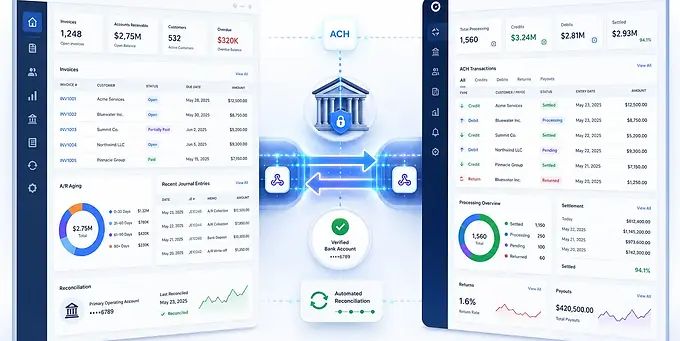
NetSuite Stripe ACH Integration Services
Accept US bank account payments through Stripe and keep your NetSuite accounting records accurate, traceable, and current.
FintegrationFS develops custom NetSuite Stripe ACH Integration solutions for US businesses, SaaS platforms, fintech companies, marketplaces, and professional service providers. We connect Stripe ACH Direct Debit workflows with NetSuite to automate customer onboarding, invoice payments, transaction updates, returns, fees, deposits, and reconciliation.
Instead of manually exporting Stripe reports and reconstructing ACH activity in NetSuite, your team receives an integration designed around its billing and accounting processes.
Discuss Your Stripe ACH Integration
What Is NetSuite Stripe ACH Integration?
NetSuite Stripe ACH Integration connects Stripe’s ACH Direct Debit payment capabilities with Oracle NetSuite. It can collect verified US bank accounts, initiate ACH payments, update invoices and customer payments, record processing fees and returns, and reconcile Stripe settlements with NetSuite accounting records.
Stripe ACH Direct Debit enables eligible businesses to collect payments from customers with US bank accounts. NetSuite manages customer records, invoices, accounting, reporting, and broader enterprise operations.
A custom integration connects these systems through a secure middleware layer. It receives Stripe events, validates payment information, applies your accounting rules, and creates or updates the appropriate NetSuite records.
ACH is a delayed-notification payment method. Therefore, the integration must handle processing states and payment failures instead of treating a submitted payment as immediately final. Stripe’s ACH Direct Debit documentation explains the underlying payment behavior.
Why Connect Stripe ACH With NetSuite?
ACH can offer a practical payment option for high-value invoices, recurring collections, and customers who prefer to pay directly from a bank account. However, managing ACH activity across disconnected systems can create additional work for finance teams.
Employees may need to confirm bank verification, monitor pending payments, update invoices, record fees, identify returned debits, and reconcile settlements manually.
A reliable NetSuite Stripe ACH Integration can help your organization:
Connect and verify eligible US bank accounts
Create Stripe ACH payments from approved invoices
Update NetSuite with processing and payment outcomes
Apply successful payments to the correct invoices
Record failed or returned ACH debits
Synchronize refunds and payment reversals
Separate gross payments from Stripe fees
Reconcile Stripe settlements and bank deposits
Support recurring bank-account payments
Maintain operational logs and audit trails
The result is a connected payment workflow, not simply a transfer of data between two APIs.
NetSuite Stripe ACH Integration Use Cases
Businesses can use NetSuite Stripe ACH Integration to collect invoice payments directly from eligible US bank accounts. A customer’s bank account can be connected and verified through Stripe, after which an authorized ACH debit can be associated with the corresponding NetSuite customer and invoice.
Stripe supports instant bank-account verification and microdeposit-based verification in applicable ACH payment flows. The appropriate method depends on the customer experience, implementation, and business requirements. Learn more about our broader Stripe integration services.
For recurring collections, verified payment details may be saved for future authorized transactions. This can support memberships, SaaS invoices, loan repayments, retainers, and other repeat billing models. The implementation must record customer authorization and follow the applicable payment and mandate requirements.
The integration can also update NetSuite as a payment moves through processing, succeeds, or fails. Returned payments may reopen an invoice, create an exception, update the customer balance, or alert the finance team.
For reconciliation, Stripe payments, refunds, fees, returns, and other balance activity can be associated with settlements before the appropriate NetSuite deposit or accounting record is created.
How Does NetSuite Stripe ACH Integration Work?
1. A NetSuite invoice becomes payable
An approved NetSuite invoice or billing record is selected for ACH collection. Customer, currency, invoice, and payment information is validated before the request proceeds.
2. The customer connects a bank account
Stripe collects the customer’s US bank account details using an eligible payment experience. Depending on the configuration, verification may occur instantly or through microdeposits.
3. Authorization is collected
The customer agrees to the required ACH debit authorization. The business should retain appropriate evidence of the authorization based on its payment flow and compliance obligations.
4. Stripe processes the payment
The integration creates the appropriate Stripe payment request. Because ACH Direct Debit is not an instant-finality payment method, NetSuite can initially show the transaction as pending rather than paid.
5. Payment events update NetSuite
Stripe webhooks notify the integration when relevant payment events occur. The middleware verifies the webhook signature, prevents duplicate processing, and updates the corresponding NetSuite records.
6. Settlement is reconciled
Successful payments, fees, returns, refunds, and adjustments are matched with Stripe balance activity and the related NetSuite transactions.
Our Stripe ACH and NetSuite Integration Services
Integration discovery and architecture
We evaluate your Stripe account, NetSuite environment, invoice lifecycle, payment volume, customer types, subsidiaries, currencies, accounting rules, and reconciliation requirements.
Bank account collection and verification
Our engineers implement an appropriate Stripe experience for securely collecting and verifying eligible US bank accounts. Stripe supports automatic verification, instant verification, and microdeposit options depending on the integration configuration.
ACH payment synchronization
We connect Stripe payment activity with NetSuite invoices, customer payments, cash sales, deposits, credit memos, refunds, journal entries, or custom records.
Webhook and payment-status management
ACH workflows must account for pending, successful, failed, returned, canceled, and refunded payments. We create event-processing logic that updates NetSuite when Stripe reports a meaningful status change.
Return and exception management
When a bank payment fails or is returned, the integration can reopen the related invoice, reverse an earlier accounting action, create a review task, or alert authorized finance employees.
Settlement reconciliation
We develop rules to match individual ACH payments, fees, refunds, and adjustments with Stripe balance activity and the corresponding NetSuite deposit.
NetSuite API and RESTlet development
Based on the required workflow, we can use NetSuite REST web services, RESTlets, SuiteScript, SuiteAnalytics, and custom records. NetSuite supports OAuth 2.0 for REST web services and RESTlets, allowing integrations to access approved resources without storing a user’s NetSuite credentials. Review Oracle’s OAuth 2.0 documentation.
Testing and production support
We test bank verification, successful collections, pending transactions, duplicate webhook delivery, insufficient-funds failures, returns, refunds, timeouts, and NetSuite validation errors before production deployment.
Security for NetSuite Stripe ACH Integration
A payment integration should minimize sensitive-data exposure while maintaining accurate records and traceable system activity.
Our implementation can include:
Encryption in transit and at rest
Secure management of Stripe and NetSuite credentials
Stripe webhook-signature verification
OAuth 2.0 authentication for NetSuite
Role-based and least-privilege access
Idempotency and duplicate-prevention controls
Sanitized logs without full bank account details
Separate development and production environments
Controlled retry and exception queues
Synchronization and administrative audit trails
Bank details should be collected through approved Stripe interfaces rather than stored unnecessarily in NetSuite or custom applications. Compliance responsibilities depend on the payment flow, business model, customer authorization process, and applicable rules.
Why Choose FintegrationFS?
FintegrationFS specializes in fintech engineering, payment integrations, and financial workflow automation. Our team understands that ACH payments behave differently from card payments and require careful handling of verification, authorization, delayed confirmation, returns, and reconciliation.
We provide:
Stripe-focused integration engineers
Custom NetSuite development
ACH workflow and exception design
Backend, cloud, QA, and DevOps support
Sandbox-to-production implementation
Documentation and knowledge transfer
Post-launch monitoring and maintenance
Explore our fintech API integration services, learn about our fintech software development services, or hire a Stripe developer.
Build a Reliable NetSuite Stripe ACH Integration
Your finance team should not have to track pending ACH payments, returns, fees, and settlements through spreadsheets.
FintegrationFS can help you design, build, test, and maintain a secure NetSuite Stripe ACH Integration aligned with your invoicing, payment, and reconciliation workflows.
Talk to Our NetSuite and Stripe ACH Experts
Frequently Asked Questions
1. What is NetSuite Stripe ACH Integration?
NetSuite Stripe ACH Integration connects Stripe ACH Direct Debit with NetSuite. It can synchronize bank-payment requests, customer information, invoice payments, processing statuses, returns, refunds, fees, and settlements.
2. Can customers pay NetSuite invoices through Stripe ACH?
Yes. A custom workflow can allow eligible customers to connect a US bank account, authorize an ACH debit, and pay a NetSuite invoice. The integration can apply a successful payment to the correct customer and invoice.
3. How are customer bank accounts verified?
Stripe ACH payment flows can support instant bank-account verification or microdeposit verification. The available method depends on the selected Stripe integration and its configuration. Bank verification should be completed before initiating the debit.
4. Are ACH payments confirmed immediately?
No. Stripe describes ACH Direct Debit as a delayed-notification payment method. The integration should represent the payment as pending until the relevant result is received, rather than immediately marking the invoice as finally paid.
5. Can failed or returned ACH payments update NetSuite?
Yes. When Stripe reports a failure or return, the integration can update the transaction, reopen the invoice, reverse an earlier entry, create a finance-team task, and preserve the return reason for review.
6. Can Stripe ACH support recurring NetSuite payments?
Yes. Verified bank payment details may be saved for future authorized collections. The implementation must define how customer consent, billing schedules, invoice creation, payment initiation, and status updates are managed.
7. Can Stripe ACH fees and settlements be reconciled in NetSuite?
Yes. The integration can separate gross collections, Stripe fees, refunds, failures, returns, and net settlement activity. These components can then be mapped to the appropriate NetSuite accounts and deposits.
8. How much does NetSuite Stripe ACH Integration cost?
Cost depends on the bank-verification experience, NetSuite records, invoice workflow, recurring-payment requirements, transaction volume, return handling, subsidiaries, reconciliation rules, historical migration, and support needs. A technical discovery provides the most reliable estimate.