What Is a Transaction Process System? Meaning, Examples, Benefits, and How It Works

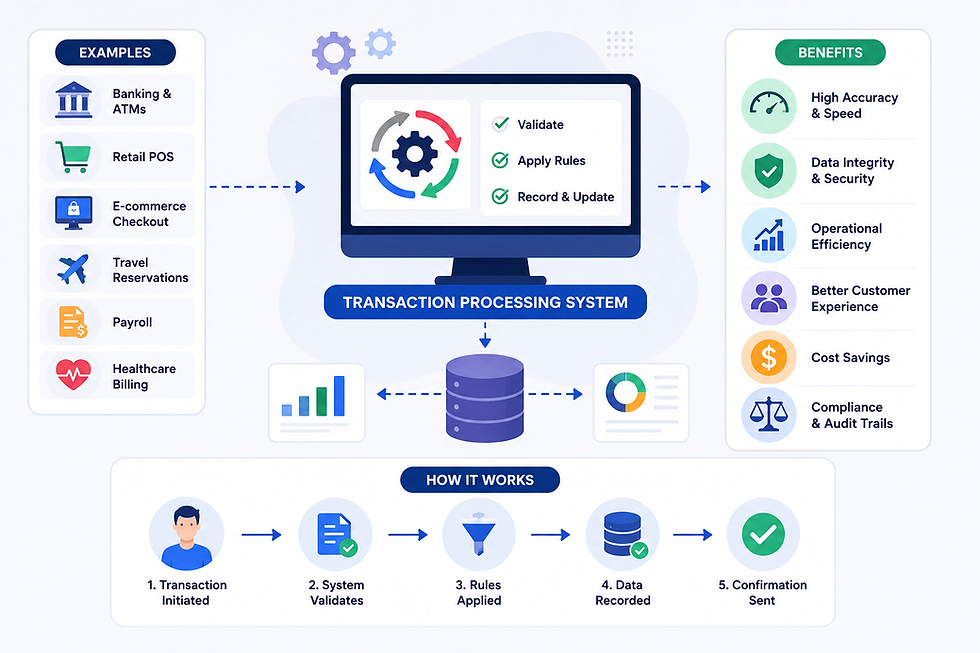
The Technology Behind Everyday Business Transactions
Before breakfast, you may tap a card at a coffee shop, transfer money in a banking app, place an online order, or clock in for work. Each action feels simple because a system behind the screen captures the details, checks the rules, updates the right records, and returns an answer—often in seconds.
People often search for “what is transaction process system,” but the standard technical term is transaction processing system, or TPS. A TPS is the operational engine that records and manages the repeatable transactions a business depends on every day. It can process money, but a transaction can also be a reservation, inventory update, refund, attendance entry, or account change.
This guide explains how a transaction processing system works, its main types and features, practical examples, business benefits, common risks, and what U.S. organizations should consider before selecting or building one.
What Is a Transaction Processing System?
A transaction processing system is software that collects, validates, processes, stores, and retrieves data created by routine business events. Its purpose is to turn an action—such as placing an order—into an accurate, durable record and the expected operational result.
The three related terms are easy to separate:
Transaction: the individual event, such as a payment, booking, purchase, or inventory movement.
Transaction processing: the checks and actions needed to accept, reject, record, or reverse that event.
Transaction processing system: the technology that coordinates those steps at business scale.
A transaction is not always financial. Opening an account, scheduling a medical appointment, approving an expense, recording a warehouse transfer, or assigning a hotel room all change organizational data and can be managed by a TPS.
Why Is a Transaction Processing System Important?
High-volume businesses cannot depend on employees manually copying every event between systems. A TPS provides consistent rules, current records, and a dependable trail of what happened. Without it, a retailer may accept an order but fail to reserve inventory, or a bank may show a balance that does not reflect a recent transfer.
A well-designed business transaction system helps a company:
Process large volumes without adding equivalent administrative headcount.
Reduce incomplete, invalid, and duplicate records.
Update accounts, orders, inventory, and connected platforms consistently.
Give customers faster confirmations and employees clearer statuses.
Create reliable source data for reconciliation, reporting, and audits.
The human benefit is just as important: employees spend less time rekeying data and more time resolving unusual cases where judgment is genuinely needed.
What Types of Transactions Does a TPS Manage?
Financial transactions
Card payments, ACH transfers, deposits, withdrawals, loan repayments, subscription charges, vendor payments, and refunds.
Sales, order, and inventory transactions
Shopping-cart checkout, invoices, discounts, returns, order cancellation, stock receipts, warehouse transfers, damaged goods, and reorder updates.
Employee and service transactions
Attendance, payroll, leave, expense claims, shift changes, appointment scheduling, hotel reservations, airline tickets, and event registration.
What defines a TPS is not the industry or the presence of money. It is the structured, repeatable handling of events that must change business records accurately.
How Does a Transaction Processing System Work?
Although the architecture varies, the transaction processing cycle usually follows eight steps:
1. Data is created. A customer, employee, device, or connected application initiates an event—for example, clicking Place Order or requesting a transfer.
2. Information is captured. The TPS collects account or customer ID, amount, product, time, channel, device, and approval details.
3. Data is validated. It checks required fields, permissions, account status, available inventory, transaction limits, and possible duplicates.
4. Business rules are applied. The system calculates tax, applies a discount, charges a fee, reserves stock, or routes an exception for approval.
5. The request is processed. The TPS authorizes a payment, creates an order, updates a balance, or reserves a seat.
6. A record is stored. The transaction database saves status, timestamps, reference numbers, user actions, and related records.
7. Confirmation is generated. The user receives a receipt, order number, message, email, or dashboard update.
8. Connected systems are updated. Accounting, CRM, ERP, analytics, fraud monitoring, and notification tools receive the relevant data.
In e-commerce, one click can therefore trigger address validation, inventory reservation, payment authorization, order creation, confirmation, and warehouse updates. The customer sees a short success message; the TPS coordinates the less visible work behind it.
Transaction Processing System Types
Batch transaction processing
Batch processing collects transactions and processes them together at a scheduled time. Payroll, end-of-day posting, bulk invoices, monthly billing, and interest calculations are common examples. It is efficient when immediate results are unnecessary, but data remains out of date until the batch runs, and one error can affect many records.
Real-time transaction processing
Real-time processing handles each request as soon as it is submitted. ATM withdrawals, card authorizations, digital wallet transfers, stock trades, airline reservations, and e-commerce checkout need quick responses. Users get current balances and inventory, but the system requires dependable infrastructure, rapid recovery, and enough capacity for traffic spikes.
Online transaction processing system (OLTP)
An online transaction processing system supports many short, concurrent database transactions. OLTP applications prioritize fast reads and writes, data integrity, and low response times. A teller platform, booking engine, point-of-sale network, or customer checkout can use OLTP even when the product itself is not described as “online” to users.
Hybrid transaction processing
Many businesses combine methods. An online store can authorize payments and reserve inventory in real time, then run settlement, reconciliation, and financial reporting in batches overnight.
Core Components and Transaction Processing System Architecture
Data-input layer: websites, mobile apps, point-of-sale terminals, ATMs, APIs, barcode scanners, devices, and employee dashboards.
Processing engine: validation, business rules, workflow orchestration, and transaction execution.
Transaction database: accounts, balances, transaction records, statuses, timestamps, and relationships.
Integration layer: secure APIs, queues, webhooks, and connectors for banks, payment gateways, accounting tools, ERP platforms, and outside services.
Security and access controls: authentication, authorization, encryption, permissions, limits, and fraud controls.
Monitoring, audit, and administration: dashboards for search, review, approval, reconciliation, correction, performance, and dispute investigation.
Transaction Processing System in DBMS
In a database management system, a transaction is a logical unit of work made up of one or more database operations. A transfer, for example, may debit one account and credit another. Treating those updates as one transaction prevents the system from completing only half the work.
Reliable transaction processing databases commonly follow the ACID properties:
Atomicity: the complete transaction succeeds, or none of it is committed.
Consistency: data moves from one valid state to another according to defined rules.
Isolation: simultaneous transactions do not interfere in a way that corrupts results.
Durability: once a transaction is committed, it remains recorded even after a restart or failure.
These database protections are foundational, but a production TPS also needs application-level safeguards such as idempotency, API authentication, reconciliation, and exception workflows.
Essential Transaction Processing System Features
Speed and capacity: low response times and enough throughput for normal and peak traffic.
Accuracy and validation: checks for missing, invalid, unauthorized, or repeated requests.
Reliability and availability: monitoring, backups, redundancy, recovery procedures, and clearly defined service targets.
Scalability: support for more users, locations, channels, products, and transaction volume.
Security and fraud protection: encryption, multifactor authentication, role-based access, transaction limits, anomaly detection, and secure APIs.
Audit trails: a searchable record of who did what, when, through which channel, and with what result.
Error handling: clear statuses, safe retries, rollback where appropriate, and manual exception review.
Integration and reporting: dependable data exchange plus operational tools for reconciliation and investigation.
Transaction Processing System Examples
Transaction processing system in banking
Banking TPS examples include deposits, withdrawals, ACH and wire transfers, card authorizations, loan repayments, fees, and balance updates. Accuracy, availability, security, and traceability are critical because even a small posting error can affect a customer’s ability to use their money.
For businesses planning a U.S. banking product, FintegrationFS explains the broader platform, integration, and operational capabilities within its digital banking solutions.
E-commerce and retail point of sale
An e-commerce TPS manages checkout, payment authorization, inventory reservation, order confirmation, refunds, and fulfillment updates. A retail point-of-sale system scans products, calculates tax, applies discounts, accepts payment, updates stock, and generates a receipt.
Reservation, payroll, healthcare, and subscriptions
Airline and hotel systems check availability and prevent double booking. Payroll systems calculate earnings and deductions before generating payment records. Healthcare systems coordinate appointments, registration, billing, claims, and prescriptions. Subscription platforms schedule recurring charges, manage failed payments, issue invoices, and change access status.
Digital banking products may combine a ledger, transaction history, payment rails, fraud controls, and operational dashboards. See this practical comparison of white-label digital banking software solutions to understand how those components can be packaged in the U.S. market.
Key Benefits of a Transaction Processing System
Faster daily operations through automated capture, validation, and routing.
Higher accuracy because the same rules are applied consistently.
A better customer experience with quick confirmations and current statuses.
Lower operating costs as teams handle more volume with less repetitive work.
Real-time visibility into sales, balances, inventory, cash flow, and demand.
Greater accountability through searchable logs and reference numbers.
Easier growth across products, channels, customers, and locations.
More dependable management reporting built on complete transaction records.
Limitations and Challenges of Transaction Processing Systems
A TPS is not automatically simple or safe. Implementation cost, legacy integrations, data migration, external-provider dependency, cybersecurity threats, changing business rules, employee training, and regulatory obligations can all add complexity. Traffic spikes and outages can also expose weak recovery design.
Automation removes repetitive work; it does not remove ownership. Teams still need someone accountable for monitoring failures, reviewing exceptions, communicating with customers, and reconciling records when systems disagree.
TPS vs. MIS, ERP, and Payment Processing Systems
System | Primary purpose | Typical data | Example |
TPS | Process routine events | Detailed, current records | Point-of-sale checkout |
MIS | Support analysis and decisions | Summarized operational data | Monthly sales dashboard |
ERP | Connect business functions | Cross-functional records | Finance, inventory, and procurement suite |
A management information system often receives its underlying data from one or more TPS platforms. An ERP may contain several transaction-processing modules, while a specialized TPS may integrate with the ERP.
A payment processing system is a narrower type of TPS focused on authorization, capture, settlement, refunds, and chargebacks. A broader TPS may also manage orders, inventory, reservations, approvals, customer records, and notifications.
How Transaction Processing Systems Handle Failures
Common failures include network interruptions, payment timeouts, database errors, duplicate requests, third-party API outages, and inventory conflicts. Resilient systems use several safeguards:
Rollback or compensating actions to reverse incomplete work.
Idempotency keys so a repeated request does not create a second charge or order.
Queues and controlled retry rules for temporary failures.
Database backups, redundant infrastructure, and tested recovery plans.
Automated reconciliation plus a manual queue for unresolved exceptions.
If a shopper taps Pay twice, for example, the TPS should recognize the repeated request and return the original outcome instead of charging the card twice. That small design choice can prevent a frustrating customer-support case.
Security Requirements for a Transaction Processing System
A secure TPS typically requires encryption in transit and at rest, multifactor authentication for sensitive access, role-based permissions, secure API credentials, data masking, audit logs, fraud and anomaly monitoring, backups, vulnerability testing, incident response, and appropriate retention and deletion rules.
U.S. requirements depend on the data and industry. Payment-card environments may need PCI DSS controls; healthcare transactions may involve HIPAA obligations; financial products may face bank-partner, consumer-protection, privacy, sanctions, and recordkeeping requirements. Compliance should be reviewed with qualified legal and compliance professionals rather than inferred from a software feature list.
How to Choose the Right Transaction Processing System
1. Define the transaction types, statuses, approvals, reversals, and reports the business actually needs.
2. Estimate average and peak volume, seasonal demand, user concurrency, and growth.
3. Choose real-time, batch, or hybrid processing based on how quickly users and connected systems need updated data.
4. Map integrations with databases, payment providers, banks, accounting software, ERP, CRM, and external APIs.
5. Evaluate security, compliance responsibilities, audit history, data location, access controls, and incident procedures.
6. Test how the system handles outages, duplicate requests, timeouts, failed webhooks, and reconciliation differences.
7. Confirm that authorized staff can search, explain, correct, export, and audit transactions without unsafe database access.
8. Calculate total cost of ownership, including licensing, development, migration, infrastructure, monitoring, support, training, and future changes.
If several financial components must work as one product, a specialist fintech software development and integration partner can help define the architecture, connect providers, test failure paths, and build the operational tools around the transaction engine.
Final Takeaway: A TPS Is the Operational Memory of a Business
A transaction processing system quietly turns customer and employee actions into accurate business records. The strongest systems do more than process quickly: they preserve data integrity, resist duplicate work, recover from failures, protect sensitive information, and give people a clear path when an exception needs human attention.
For a U.S. retailer, fintech, healthcare platform, subscription company, or service business, the right TPS can improve speed, accuracy, visibility, and customer trust. The right choice starts with a precise understanding of the transactions, rules, risks, integrations, and people the system must support.
Frequently Asked Questions
1. What is a transaction process system in simple terms?
The phrase usually refers to a transaction processing system, or TPS. It is software that receives a routine business event, checks it, applies rules, records the result, and updates related data. A card purchase, appointment booking, payroll entry, and inventory movement can all be TPS transactions.
2. What are common transaction processing system examples?
Common examples include ATM and banking systems, retail point-of-sale software, e-commerce checkout, airline and hotel reservations, payroll, healthcare billing, and subscription platforms. Each handles repeatable events that must be recorded accurately.
3. What are the main transaction processing system types?
The main types are batch processing, which handles a group of transactions on a schedule; real-time processing, which responds to each transaction immediately; and hybrid processing, which combines both approaches. OLTP is the database-oriented model used for many fast, concurrent transactions.
4. What is a transaction processing system in DBMS?
In a DBMS, a transaction is a logical unit of database work. The system commits all required changes together or rolls them back when the operation cannot complete. ACID properties help keep data accurate when failures or simultaneous requests occur.
5. What features should a business look for in a TPS?
Look for fast and accurate processing, reliable availability, scalability, transaction integrity, encryption, role-based access, fraud controls, audit trails, safe retries, duplicate prevention, reconciliation, reporting, and secure integrations. The best feature set depends on the business’s transactions and regulatory obligations.


