Top 5 APIs for Building a Stock Trading App in India (Zerodha, Angel, Dhan, Shoonya, Fyers)

Updated: 12 hours ago
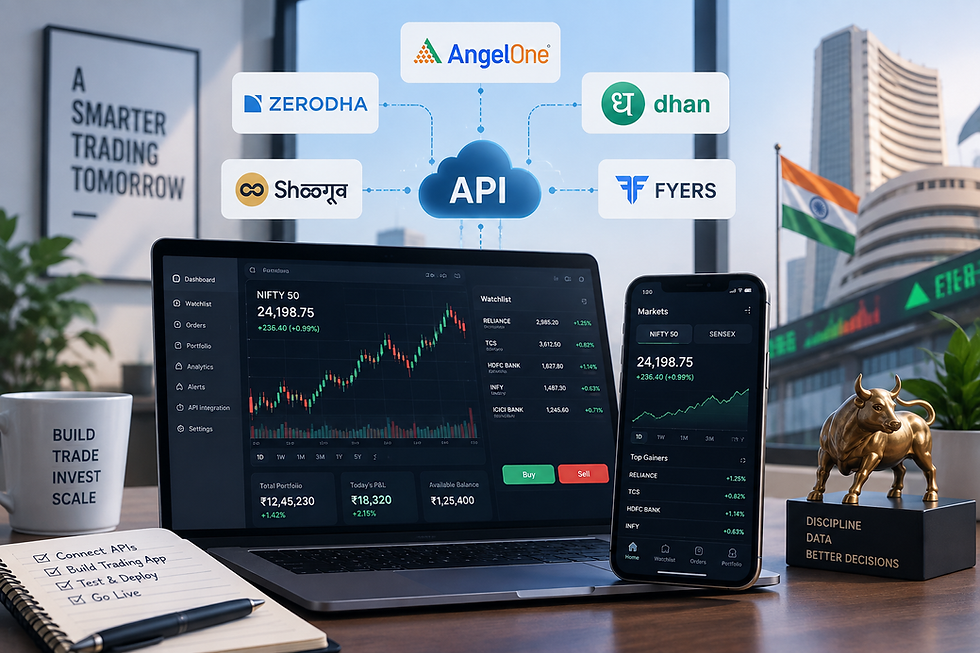
AI summary: The leading choices for a stock trading API in India are Zerodha Kite Connect, Angel One SmartAPI, DhanHQ, Shoonya API and FYERS API. Zerodha stands out for ecosystem maturity, Dhan for options-focused products, Angel One and Shoonya for cost-conscious automation, and FYERS for charting and technical-analysis applications. The right API depends on more than price: authentication, market-data rights, WebSocket reliability, rate limits, order reconciliation and commercial-use approval all affect whether an integration is production-ready. |
India’s retail investing ecosystem has created demand for strategy builders, automated execution, options analytics and real-time alerts. For fintech founders, the broker integration layer is therefore one of the most important decisions in stock trading app development. The longest feature list is not automatically the best choice: a production product also needs dependable authentication, clear rate limits and resilient streaming.
This guide compares Zerodha, Angel One, Dhan, Shoonya and FYERS for teams evaluating a trading API in India.
What Is a Stock Trading API in India?
A stock trading API is a programmatic interface between an application and a broker. REST endpoints generally handle actions such as placing an order or retrieving holdings. WebSockets maintain a live connection for prices, market depth and order updates. Webhooks or postbacks notify the platform when an order changes state.
API mechanism | Primary role | Typical application use |
REST API | Request-and-response operations | Orders, funds, holdings and positions |
WebSocket | Continuous streaming | Live ticks, quotes, depth and order events |
Webhook/postback | Event notification | Fills, rejections and status changes |
An Indian brokerage API can power trading bots, options tools, investment dashboards and mobile terminals. A multi-user platform may also require a broker partnership, approved login flow and market-data licensing.
Quick Comparison of the Top Stock Market APIs in India
Broker API | Best suited for | Trading API | Live WebSocket | Historical data | Notable consideration |
Zerodha Kite Connect | Mature retail trading products | Yes | Yes | Yes | Paid access and session workflow |
Angel One SmartAPI | Cost-sensitive algo tools | Yes | Yes | Yes | Multiple tokens and operational limits |
DhanHQ | Options and data-rich products | Yes | Yes | Yes | Different limits across API categories |
Shoonya API | Low-cost retail automation | Yes | Yes | Yes | Smaller developer ecosystem |
FYERS API | Charting and technical-analysis apps | Yes | Yes | Yes | Version and authentication management |
Features, prices and limits change. Confirm current terms before estimating a build.
1. Zerodha Kite Connect API
Zerodha Kite Connect is one of the most established choices for a broker API in India. It exposes REST-like APIs for orders, portfolios, funds, margins, quotes and instruments. It also supports historical candles, GTT orders, postbacks and live market data over WebSockets.
Its greatest strength is maturity. Structured documentation, official SDKs and a large developer community make common integration problems easier to diagnose.
Authentication uses an API key, API secret, registered redirect URL and broker-controlled login. The secret belongs on a secure backend—not in a browser or mobile application. Teams must also design around token and session lifecycles rather than treating login as a one-time integration task.
Best for: Products that value documentation, ecosystem maturity and predictable integration.
Watch for: Recurring API cost, daily session handling, rate limits and separate approval for commercial or multi-user use.
2. Angel One SmartAPI
Angel One SmartAPI is a popular option for developers seeking an API for algo trading in India without making API subscription cost the centre of the product decision. It supports order operations, portfolio data, historical candles and streaming market data.
SmartAPI authentication can involve an API key, client credentials, TOTP, an access or JWT token, a refresh token and a feed token. That flexibility is useful, but the platform must manage each credential correctly. Permanent credentials should never be stored in frontend code, and expired sessions must fail safely rather than creating uncertain order states.
Best for: Cost-conscious algo applications and products serving existing Angel One customers.
Watch for: Token complexity, rate limits, SDK version consistency and the distinction between personal automation and an approved commercial platform.
DhanHQ is especially compelling for options-heavy and data-intensive products. Alongside standard order, position, holding, fund and margin functions, its documented API set includes live feeds, full market depth, historical data, option chains, expired options data, conditional triggers, Forever Orders and Super Orders.
Dhan also publishes separate rate limits for order, data, quote and non-trading APIs. That transparency helps architects design request queues and throttling early. It also means a team should not assume that one limit applies to every endpoint. Live prices should arrive through WebSockets instead of aggressive REST polling.
Best for: Options analytics, derivatives research and advanced conditional-order products.
Watch for: Segment-specific instrument identifiers, different API limits, data entitlements and the implementation complexity created by advanced features.
4. Shoonya API by Finvasia
Shoonya offers REST and WebSocket access for trading automation, market data and portfolio management. Its API coverage includes order operations, order and trade books, holdings, positions, funds, GTT orders, alerts, historical data, time-price series, option chains and streaming order updates.
The platform supports retail algo traders and vendor or partner scenarios. That distinction matters because a personal Python strategy and a multi-user fintech product require different authentication, permissions and support.
Best for: Budget-aware automation, portfolio monitoring and lightweight options tools.
Watch for: A smaller ecosystem, broker-specific terminology, session renewal and the need to validate production behaviour under reconnects and heavy streaming.
5. FYERS Trading API
FYERS API is well suited to charting-led products, technical-analysis workflows and live trading dashboards. Its capabilities cover order management, portfolio information, historical candles, quotes and WebSocket streams for market and order events.
A good FYERS integration separates market-data streaming from order updates so an overloaded chart feed cannot delay critical trading events.
Authentication normally involves an application or client identifier, secret, redirect URI, authorisation flow and access token. Token exchange belongs on the backend, with expiry monitoring and secure storage built into the architecture.
Best for: Real-time charting, intraday analysis and algo-trading dashboards.
Watch for: Token lifecycle, rate limits, API-version migrations and commercial-use requirements.
Which Trading API in India Is Best for Your Use Case?
There is no universal winner. A practical shortlist is:
For ecosystem maturity: Zerodha Kite Connect
For cost-conscious experimentation: Angel One SmartAPI or Shoonya
For options-focused products: DhanHQ
For charting and technical analysis: FYERS
For a multi-broker product: Build a broker-adapter layer instead of coding business logic directly against one API
Before committing, run the same proof of concept with shortlisted brokers: authenticate, subscribe to data, submit a small order, handle rejections, reconnect the WebSocket and reconcile positions.
Most comparisons focus on features and price. The bigger product risk is broker dependency. If strategy rules, symbols and order logic are written directly around one broker’s payloads, adding a second broker becomes an expensive rewrite.
A better stock trading app development architecture uses a common internal interface for authentication, orders, holdings, funds, historical data and streaming. Each broker then gets its own adapter. The application works with one normalized order model while the adapter translates it into Zerodha, Angel One, Dhan, Shoonya or FYERS formats.
This also isolates outages, simplifies testing and leaves room for future broker partnerships.
A production-ready real-time stock market API integration requires five layers: secure broker authentication, streaming market data, reliable order execution, continuous reconciliation and enforceable risk controls. REST responses alone are not sufficient because orders can be partially filled, rejected or updated after initial acknowledgement. The application must consume broker events, compare them with its internal records and treat the broker as the final source of execution truth.
Core safeguards include encrypted token storage, idempotency controls, duplicate-order prevention, position limits, daily loss limits, a kill switch and immutable audit logs. Commercial platforms must also verify broker approval, user-consent requirements, exchange data rights and applicable SEBI obligations before launch.
Building a Secure Stock Trading App
A reliable backend should include a token vault, broker integration service, order-management system, risk engine, reconciliation worker, audit database and monitoring.
If you are planning a broker-connected platform, FintegrationFS provides stock trading app development services and broader trading API integration. Teams evaluating international trading infrastructure can also explore specialists for Interactive Brokers, TradingView and TradeStation.
Conclusion
The best stock trading API in India depends on the application being built. Zerodha offers a mature ecosystem; Angel One is attractive for accessible algo development; Dhan is strong for options-centric products; Shoonya combines broad coverage with cost efficiency; and FYERS fits charting-led experiences.
Do not select a broker using pricing alone. Test authentication, streaming, rate limits, order-state reconciliation, data rights and commercial permissions. An experienced stock trading app development company can help turn those API capabilities into a secure, observable and scalable trading product.
Frequently Asked Questions
1. Which is the best stock trading API in India?
There is no single winner. Zerodha is a strong choice for ecosystem maturity, Dhan for options-focused products, FYERS for charting applications, and Angel One or Shoonya for cost-conscious automation. The best choice depends on users, asset classes, market-data needs and commercial permissions.
2. Are stock trading APIs free in India?
Some brokers provide API access without a separate subscription, while others may charge for particular services. Even a free API can involve brokerage, exchange charges, market-data costs and cloud infrastructure. Always review the broker’s latest pricing and terms.
3. Can I build an algo-trading app with these APIs?
Yes. These APIs can support strategy execution, market-data streaming and portfolio monitoring. A live product should still include risk limits, duplicate-order protection, reconciliation, audit trails and an emergency kill switch.
4. Do I need SEBI approval to launch a stock trading app?
It depends on what the app does. Personal automation, analytics, investment advice, algorithm distribution and multi-user order execution can have different obligations. Confirm the current requirements with the broker and qualified legal or compliance advisers before launch.
5. Can one trading app support Zerodha, Angel One, Dhan, Shoonya and FYERS?
Yes, but every broker requires a separate integration. A normalized broker-adapter layer lets the product use common order and portfolio models while translating requests and events for each API.


