Open Banking vs Embedded Finance: Understanding the Key Differences

Updated: Sep 22
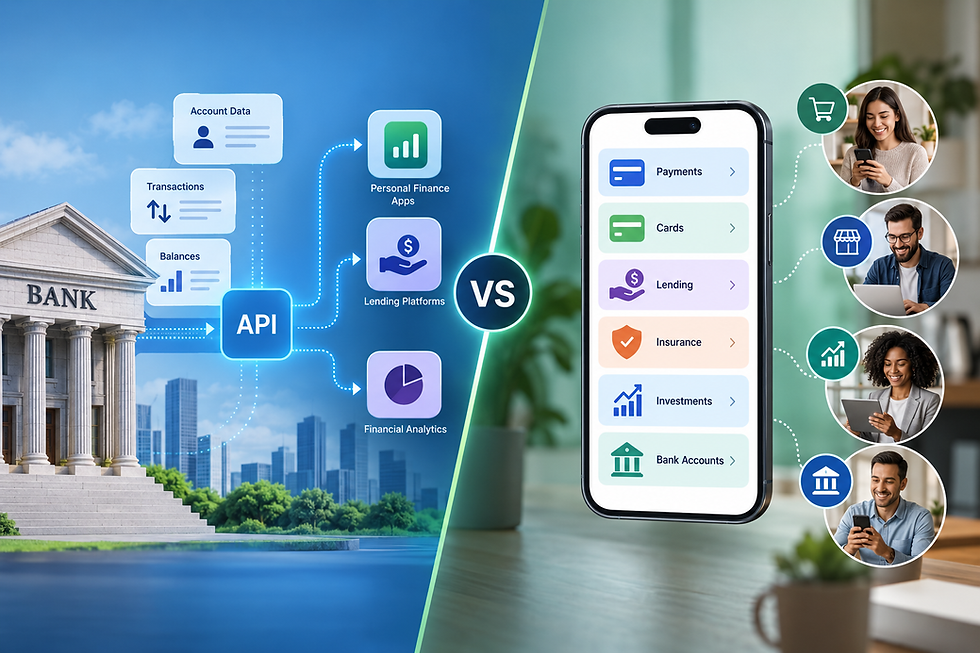
AI Summary: Open banking and embedded finance both use APIs and financial technology to make financial services more connected, but they solve different problems. Open banking primarily enables consumers and authorized third parties to securely access financial data or initiate certain banking-related actions. Embedded finance places financial products such as payments, lending, cards, accounts, or insurance directly inside a non-financial product or customer journey. In practice, the two can work together—for example, a lending platform can use open banking data to understand cash flow and embedded finance to deliver the loan inside its own application. |
Introduction: Why Open Banking vs Embedded Finance Matters
Financial services no longer have to live inside a traditional banking app. A customer can connect a bank account to a budgeting tool, pay inside a marketplace, receive financing through business software, or access a financial account without switching to a separate banking experience.
That shift has made open banking and embedded finance two important concepts in modern fintech.
The terms are sometimes used interchangeably, but the open banking vs embedded finance difference is easier to understand when you look at what each one is designed to do.
Open banking is primarily about secure financial-data access and connectivity. Embedded finance is primarily about putting financial products into an existing digital experience.
For U.S. businesses building fintech products, SaaS platforms, marketplaces, or financial workflows, understanding this distinction can influence product architecture, API selection, compliance planning, and the type of fintech development services required.
What Is Open Banking?
Open banking is a model that allows consumers to authorize access to financial information and, depending on the service and applicable framework, certain banking actions through secure technology such as APIs.
In the U.S., the Consumer Financial Protection Bureau (CFPB) finalized a Personal Financial Data Rights rule in 2024 intended to give consumers greater ability to access and share financial data with authorized third parties. However, the CFPB states that the rule's compliance dates were stayed by a court in October 2025, so businesses should verify the current regulatory position before designing around specific compliance dates.
At a practical level, open banking can connect a customer's financial accounts with an application that needs permissioned financial information.
How Open Banking Works
A simplified open banking flow looks like this:
Customer → Third-Party Application → Open Banking API/Data Provider → Financial Institution → Authorized Financial Data → Application
The workflow generally involves:
Customer authorization — The customer gives permission for an application or authorized third party to access specified information.
Authentication — The customer or institution verifies access.
API request — The application requests permitted financial information.
Financial institution/data provider response — Relevant information is returned through the available connection.
Data processing — The application organizes or analyzes the information.
Consent and privacy management — Access should be governed by appropriate authorization, privacy, security, and retention controls.
The CFPB identifies use cases including personal financial management, payment applications and digital wallets, credit underwriting—including cash-flow underwriting—and identity verification.
Open Banking Use Cases
Common use cases include:
Bank account aggregation
Personal finance management
Income verification
Account verification
Cash-flow analysis
Credit underwriting
Payment initiation
Financial-data enrichment
Automated financial reporting
Benefits of Open Banking
Open banking can help businesses:
Reduce manual financial-data entry
Automate account and income verification
Build richer financial profiles
Improve financial decision-making
Create more personalized experiences
Connect financial accounts to digital workflows
Reduce friction in financial applications
Open Banking Challenges
The technical connection is only one part of the problem. Businesses also need to think about:
Data privacy
Customer authorization and consent
Authentication
API reliability
Data quality and normalization
Security
Regulatory requirements
Third-party risk
Data retention and access controls
For U.S. fintech products, these considerations should be addressed early rather than added after the API integration is complete.
What Is Embedded Finance?
Embedded finance means integrating financial services directly into a non-financial product, platform, or customer journey.
Instead of sending a customer to a separate bank or financial-services website, a business can make a financial function available within the product the customer is already using.
Examples include:
Payments inside a marketplace
Business accounts inside SaaS software
Cards inside an expense-management platform
Financing inside an ecommerce workflow
Insurance during a purchase
Financial accounts inside a business platform
APIs and SDKs are commonly used to connect the platform with financial infrastructure, while banks, payment providers, fintech infrastructure companies, and other regulated partners may provide the underlying services.
How Embedded Finance Works
A simplified embedded-finance architecture looks like:
Customer → Non-Financial Platform → Embedded Financial Product → Financial Infrastructure Provider → Bank/Financial Institution
The platform typically owns the customer experience, while specialized financial partners may provide infrastructure, regulated services, payments, accounts, cards, lending, or compliance capabilities.
Types of Embedded Finance
Embedded Payments
Customers can pay directly inside a marketplace, SaaS application, ecommerce platform, or other digital experience.
Embedded Banking
Platforms can provide financial account functionality such as business accounts or money-management features through financial infrastructure partners.
Embedded Lending
Businesses can integrate financing, merchant funding, or other credit products into an existing customer journey.
Embedded Cards
Platforms can offer virtual or physical cards as part of an expense, payroll, marketplace, or business-management experience.
Embedded Insurance
Insurance can be presented within the purchase or service experience where coverage is relevant.
Embedded Investments
Investment functionality can be integrated into an application rather than requiring customers to use a separate investment platform.
Open Banking vs Embedded Finance Difference: Key Differences
The simplest way to understand the difference between open banking and embedded finance is:
Open banking focuses on connecting to financial data and banking capabilities. Embedded finance focuses on delivering financial products inside a non-financial experience. |
Factor | Open Banking | Embedded Finance |
Primary purpose | Connect consumers and applications to financial data/services | Integrate financial products into an existing product experience |
Main focus | Financial connectivity and data access | Financial functionality and customer experience |
Typical technologies | Open banking APIs, data connections, authentication | APIs, SDKs, BaaS and financial infrastructure |
Common use cases | Account aggregation, verification, underwriting | Payments, cards, accounts, lending |
Typical users | Fintechs, financial apps, banks and data-driven platforms | SaaS companies, marketplaces and digital platforms |
Customer interaction | Authorizes financial data access or banking action | Uses a financial product within the platform |
Core challenge | Secure, reliable and permissioned data access | Product, regulatory, financial-partner and operational complexity |
Open Banking and Embedded Finance: How Are They Related?
Open banking and embedded finance are not competing technologies. A single fintech product can use both.Consider an online lending platform.
First, the customer connects a bank account. The platform uses open banking technology to retrieve permissioned financial information and analyze income or cash flow.
Then the platform presents a financing offer and lets the customer complete the application without leaving the product. The loan experience is an example of embedded finance.
The combined workflow looks like:
Open Banking
Connect account → Retrieve transaction data → Analyze cash flow → Verify financial information
Embedded Finance
Present financing → Complete application → Deliver financial product → Manage repayment
This combination is particularly relevant when building modern fintech platforms where financial data and financial services need to work together.
Open Banking vs Embedded Finance Examples
Example 1: Personal Finance Application
A personal finance app can use open banking to connect multiple accounts and organize balances and transactions.
The core value comes from financial-data connectivity and analysis.
Example 2: Ecommerce Marketplace
A marketplace can embed payments directly into its checkout flow.
The customer does not need to leave the marketplace to complete the transaction. The financial service becomes part of the platform experience.
Example 3: Accounting SaaS
An accounting platform can use open banking to retrieve transaction data while also embedding payments, business cards, or financing.
This illustrates why open banking and embedded finance can coexist inside one product.
Example 4: Lending Platform
A lending application can use permissioned financial data to support underwriting and then embed the financing journey into the platform.
Technology Behind Open Banking and Embedded Finance
Both models depend heavily on modern fintech infrastructure, but the technology requirements can differ.
APIs
Depending on the product, APIs may support:
Account information
Transactions
Identity
Payments
Cards
Account creation
Lending workflows
Data Aggregation
Open banking applications often need capabilities for:
Account aggregation
Transaction categorization
Balance retrieval
Income verification
Financial-data normalization
Banking-as-a-Service and Financial Infrastructure
Embedded finance may require infrastructure for:
Accounts
Payments
Cards
Lending
Money movement
Compliance workflows
Security and Compliance
Security architecture can include:
OAuth or similar authorization mechanisms
Encryption
Tokenization
Multi-factor authentication
Secure API authentication
Fraud controls
Identity verification
Consent management
KYC/AML processes where applicable
The exact requirements depend on the financial product, partners, customer type, jurisdiction, and regulatory responsibilities.
Fintech Software Development Considerations
Choosing between open banking and embedded finance is not only a product decision. It is also a fintech software development decision.
A development team may need to handle API integrations, authentication, financial-data normalization, transaction processing, webhooks, error handling, security controls, audit trails, and partner-specific requirements.
For companies evaluating software development for fintech, the key questions should include:
What financial problem are we solving?
Do we need financial data, financial functionality, or both?
Which financial APIs are required?
Which regulated partners are involved?
What customer consent is required?
What KYC/AML or payment obligations apply?
How will failed API calls and transactions be handled?
How will sensitive financial information be secured?
Can the architecture scale to additional providers and products?
A strong architecture matters because financial workflows rarely end with a successful API response. Real-world systems also need retries, reconciliation, monitoring, webhooks, exception handling, auditability, and clear customer communication.
Many articles explain open banking and embedded finance as if the challenge ends once APIs are connected. In production, the operational layer can be just as important as the integration itself. For example, a fintech platform may successfully connect to an account or initiate a payment, but what happens when:
This is where mature fintech solution development differs from simply connecting an API. A scalable implementation should account for: Integration → Validation → Transaction processing → Monitoring → Reconciliation → Exception handling → Audit trail This operational layer is especially important for businesses working with fintech software development companies or a fintech software development agency because reliability and recoverability can directly affect customer trust. |
Which Approach Should a Business Use?
There is no universal answer. The right approach depends on the product requirement.
Open Banking May Fit When You Need To:
Connect customer-permissioned financial accounts
Retrieve transaction information
Verify income or account information
Analyze cash flow
Build financial insights
Support data-driven underwriting
Embedded Finance May Fit When You Want To:
Add payments to your platform
Offer financial accounts
Provide cards
Integrate lending
Add financial services to a SaaS workflow
Monetize financial activity inside your product
You May Need Both When:
Your product requires financial data and financial products
You are building a lending platform
You are creating a financial-management platform
Your SaaS product needs both account connectivity and payments
Your marketplace needs financial data, payments, and payouts
How to Implement Open Banking
A practical implementation process can include:
Define the use case — Identify exactly what financial information or action the product requires.
Map the customer journey — Determine where authorization, data access, and financial actions occur.
Select providers — Evaluate coverage, reliability, security, documentation, pricing, and support.
Integrate APIs — Build the required connections and authentication flows.
Implement consent controls — Make access understandable and manageable for customers.
Secure financial data — Apply appropriate security, access, logging, and retention controls.
Handle failures — Design for expired connections, unavailable institutions, timeouts, duplicates, and retries.
Monitor integrations — Track availability, errors, latency, and data quality.
Review compliance requirements — Validate the applicable U.S. federal and state requirements with qualified legal/compliance professionals.
How to Implement Embedded Finance
A typical embedded-finance implementation can follow these steps:
Choose the financial product — Payments, accounts, cards, lending, or another service.
Design the customer experience — Make the financial workflow feel native to the product.
Select financial infrastructure — Evaluate providers and regulated partners.
Define responsibilities — Clarify who handles KYC, AML, fraud, money movement, disputes, and support.
Build API integrations — Connect the product to the selected financial infrastructure.
Implement security controls — Protect financial and customer information.
Test edge cases — Include failed payments, rejected applications, provider downtime, duplicate events, and partial failures.
Build monitoring and reconciliation — Ensure financial events can be tracked and reconciled.
Launch gradually — Monitor customer behavior, operational issues, and financial performance before scaling.
Open banking and embedded finance are related but different. Open banking primarily enables secure, permissioned access to financial data or banking capabilities through technology such as APIs. Embedded finance integrates financial products—such as payments, lending, cards, accounts, or insurance—directly into a non-financial company's product or customer journey. A fintech platform can use both: open banking to access authorized financial information and embedded finance to deliver a financial service inside the same application. |
Final Takeaway
The open banking vs embedded finance distinction comes down to the role financial services play in a product.
Open banking is primarily about financial connectivity and permissioned data access. Embedded finance is primarily about integrating financial products into an existing customer experience.
They can also complement each other. A fintech platform may use open banking to retrieve financial information and embedded finance to turn that information into a financial service.
For businesses investing in fintech software development services, the important decision is not simply which buzzword to use. Start with the customer problem, define the financial capability required, map regulatory and operational responsibilities, and then select the API and infrastructure architecture that can support the product at scale.
Frequently Asked Questions
1. What is the difference between open banking and embedded finance?
Open banking primarily connects customers and authorized applications to financial data or banking capabilities through secure technology such as APIs. Embedded finance integrates financial products such as payments, cards, accounts, or lending directly into a non-financial product or customer journey.
2. Can open banking and embedded finance work together?
Yes. A lending platform, for example, can use open banking to access authorized transaction data for financial analysis and then use embedded finance to deliver financing inside the same application.
3. What are common open banking vs embedded finance examples?
Open banking examples include account aggregation, transaction-data access, income verification, and cash-flow underwriting. Embedded finance examples include marketplace payments, embedded cards, business accounts, lending, and insurance integrated into digital platforms.
4. Does embedded finance require a bank?
Not necessarily in the sense that the platform itself must be a bank. Many businesses use financial infrastructure providers and regulated financial partners to provide services such as payments, accounts, cards, or lending while the business owns the customer-facing product experience.
5. What should businesses consider when building fintech software?
Businesses should consider the customer use case, required APIs, financial partners, security, data privacy, compliance responsibilities, KYC/AML requirements where applicable, API reliability, reconciliation, monitoring, exception handling, and scalability. For complex products, experienced fintech development services can help translate these requirements into a production-ready architecture.


