Essential Features Every Stock Trading App Needs to Compete in India & the US

Updated: 3 days ago
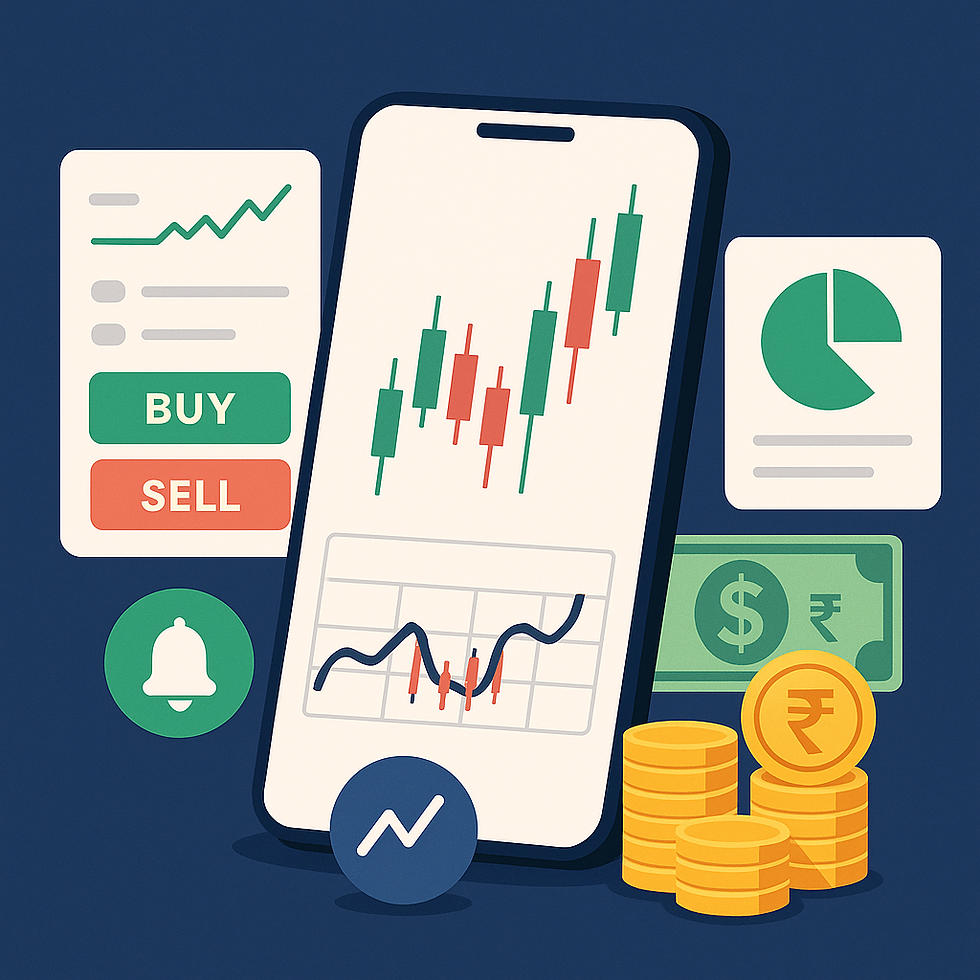
Quick AnswerA competitive stock trading app needs secure onboarding, real-time market data, watchlists, charting tools, reliable order management, portfolio tracking, fast funding, risk controls, and responsive support. For teams building trading app development USA and India products side by side, the trickiest part isn't the feature list — it's localizing KYC, funding rails, and tax reporting for each market without duplicating the entire codebase. |
Why "Just Add More Features" Doesn't Work Anymore
Retail investors don't benchmark a trading app against other brokerages anymore — they benchmark it against their banking app, their payment app, whatever they used last. That's a much higher bar, and it means the basics (fast orders, clear pricing, a portfolio view that actually makes sense) have to work before anything fancy gets added on top.
This is also where a lot of stock market app development projects go sideways: teams try to build one product for two very different regulatory environments. India and the US share a lot of the same shape — onboarding, data, orders, portfolio, funding — but the substance underneath each of those pieces is genuinely different. Below is a practical map of the stock trading app features that matter, with US and India specifics called out where they diverge.
Stock Trading App Features at a Glance
Feature Category | Essential for MVP | Competitive Advantage | US-Specific Note |
Onboarding & KYC | Yes | Yes | SSN/TIN, CIP checks, trusted contact |
Real-time market data | Yes | Yes | NYSE/Nasdaq feeds, extended-hours pricing |
Watchlists & alerts | Yes | Yes | Multi-market, multi-asset filters |
Charting & technicals | Yes | Yes | Split-adjusted history, dividend overlays |
Order management | Yes | Yes | Order types, PDT rules where applicable |
Portfolio & tax reporting | Yes | Yes | Cost basis, tax lots, wash-sale flags |
Funding | Yes | Yes | ACH, wire, instant deposit limits |
Risk controls | Yes | Yes | Margin rules, concentration warnings |
Fractional shares | Optional | Widely expected | Common differentiator for US retail |
Options tools | Segment-dependent | Yes | Chains, Greeks, approval levels |
AI insights | No | Yes | Personalization, research summarization |
Regulatory specifics should always be confirmed with compliance counsel and the broker-of-record — this table is a planning reference, not legal guidance.
1. Onboarding That Doesn't Lose Users Halfway Through
Progressive registration — asking for identity info, then financial profile, then disclosures, in stages rather than all at once — consistently improves completion rates. For trading app development USA builds, that flow typically includes SSN or TIN collection, Customer Identification Program (CIP) checks, employment and affiliation questions, and a trusted-contact field, followed by account agreements and (where relevant) options or margin approval.
The part teams underestimate: recovery. Save-and-resume, clear rejection reasons, and easy document resubmission matter as much as the happy path, because a chunk of applicants will drop off at the identity-verification step no matter how good the UX is.
2. Real-Time Market Data Isn't Optional Anymore
Live quotes — last price, bid/ask, volume, OHLC, and a visible data timestamp — are table stakes. What separates a functional app from a good one is the plumbing behind it: persistent WebSocket connections with heartbeats, reconnection logic, and stale-price detection so the interface never shows a number the user can't trust.
One thing that trips up new entrants: market-data licensing is not the same thing as API access. Having a data feed doesn't automatically grant rights to display it to customers, store it, or build derived analytics from it. That's a contract conversation, not just an engineering one. Teams evaluating a trading API for this layer should confirm display and redistribution rights before committing to a vendor.
3. Watchlists, Charts, and the Research Layer
A watchlist that syncs across devices, supports multiple lists, and shows mini-charts and volume alongside price is the minimum. The competitive version adds custom columns, tags, portfolio comparison, and screener-to-watchlist conversion.
Charting needs candlestick and line views, multiple timeframes, and a working set of indicators (moving averages, RSI, MACD, VWAP) with drawing tools layered on top. For US products specifically, that means pre-market and after-hours pricing, split-adjusted history, and dividend/earnings overlays — details that get missed when a chart module is ported over from a different market without adjustment.
Teams that don't want to build charting in-house often integrate an existing library rather than reinvent it; this is one of the more common reasons product teams look to hire a TradingView developer rather than building candlestick and indicator logic from scratch.
4. Order Entry and Trade Management
Order support (market, limit, stop, stop-limit, day, GTC) needs to come with a genuine order preview — instrument, quantity, price, estimated fees, available buying power — before the user taps confirm. Pre-trade validation should catch buying-power issues, tick-size violations, and price-band breaches before they ever reach the broker.
For options-oriented online trading app features, that expands into option chains, Greeks, implied volatility, open interest, payoff diagrams, and approval-level checks for multi-leg strategies.
Post-order, users need real-time status (submitted, partially filled, filled, rejected, expired) and a visible order timeline. A broker's initial API acknowledgment is not proof of execution — the app has to reconcile its own records against the broker's, or discrepancies quietly accumulate. This reconciliation layer is one of the reasons founders often bring in specialized interactive brokers developers or Saxo Bank developers rather than treating broker integration as a generic REST-API task.
5. Portfolio Tracking and Tax Reporting
Beyond current value and unrealized gain/loss, competitive portfolio tools add time-weighted returns, benchmark comparison, sector allocation, and drawdown analysis. For US accounts specifically, cost basis, tax lots, realized/unrealized gains, wash-sale flags, and year-end tax documents are expected — not optional add-ons.
6. Funding, Buying Power, and Fraud Controls
US funding typically runs through ACH and wire, with instant-deposit limits and clear withdrawal-hold rules. What matters to users is transparency: available cash vs. settled/unsettled funds, pending deposits, processing time, and a plain-language reason when a transfer fails. On the fraud side, name matching, verified-account checks, device monitoring, and velocity checks on transfers are standard now, not advanced features.
7. Risk Controls and Security
User-level controls (max order value, position limits, margin alerts, concentration warnings) pair with platform-level controls (duplicate-order prevention, idempotency, rate limiting, trade surveillance, an emergency kill switch). Security fundamentals — MFA, biometrics, encrypted data in transit and at rest, role-based access, WAF/DDoS protection, and regular penetration testing — aren't differentiators anymore; skipping any of them is now a liability.
8. AI Features Worth Adding (and Ones to Avoid)
AI can genuinely help with portfolio-risk summaries, duplicate-exposure detection across holdings, personalized education, and support-ticket triage. It should stay away from unsupported return predictions, guaranteed trade calls, and any explanation presented as regulated financial advice. Cited sources and clear timestamps on AI-generated summaries matter more than the novelty of having AI at all.
Most comparisons of trading platforms focus on what's visible — charts, order speed, UI polish. But users judge a platform hardest when something goes wrong: a delayed withdrawal, a rejected order with no clear reason, an outage with no status update. Clear rejection reasons, visible data timestamps, transparent fees, a real system-status page, and proactive incident communication do more for retention than any single new feature. A trading app isn't defined only by how fast a user can place an order — it's defined by whether they can understand, verify, and recover every important financial action afterward.
The essential features of a stock trading app are secure onboarding, real-time market data, instrument search, watchlists, charting tools, order management, portfolio tracking, account funding, risk controls, notifications, and customer support. Production-grade apps also require trade reconciliation, audit logging, security monitoring, and confirmed market-data licensing rights. |
Building vs. Integrating: Where Most Teams Get Stuck
A lot of the feature list above assumes broker and data connectivity that most teams don't want to build from zero. Whether that's stock trading app development end-to-end, or narrower integrations like a Saral Stock API setup, the practical decision is usually about which layers to build in-house and which to integrate — not whether to build every feature on this list at once.
Building this out for a US or India audience? Start with the stock trading app development page, or reach out through FintegrationFS to talk through which layers make sense to build versus integrate.
FAQs
1. What are the most important stock trading app features for a new platform?
Secure onboarding, live pricing, instrument search, watchlists, order placement and tracking, portfolio management, funding, and basic risk controls. Everything else — AI, advanced analytics, options — is worth adding only after these work reliably.
2. Is real-time market data mandatory for a trading app, or can it launch with delayed data?
It depends on the product and audience, but any app marketed as a live trading tool needs timely prices and a visible data timestamp so users know exactly how fresh what they're looking at is. The required feed depth and licensing terms depend on the data vendor and customer type.
3. Should a new trading app include options trading from day one?
Only if the target audience actually needs it and the platform can support approval workflows, real-time Greeks, and multi-leg order handling properly. Bolting on options before the core buy/sell flow is solid tends to backfire.
4. How long does building a competitive stock trading app actually take?
A focused MVP covering onboarding, data, orders, and portfolio can realistically take a few months. A multi-broker platform with options, tax reporting, and AI features is a longer, phased roadmap — not a single build.
5. Can one app connect to multiple brokers instead of picking just one?
Yes, with a broker-adapter layer that normalizes authentication, order placement, and portfolio retrieval across providers. It's more setup work upfront but avoids locking the product into one broker's API quirks later.


