Best Engagement Models When You Hire a Dedicated Plaid Developer

Updated: Sep 29
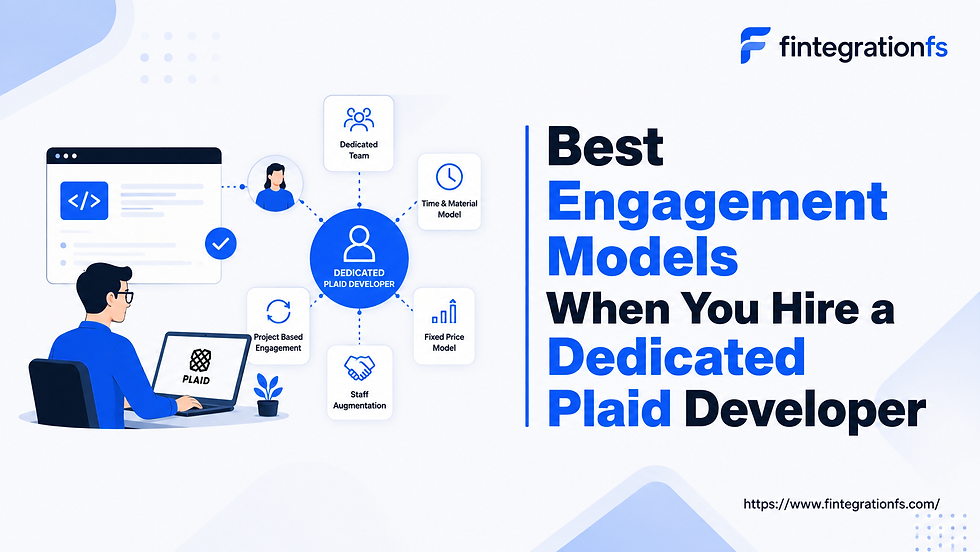
AI SummaryHiring a dedicated Plaid developer gives fintech teams flexibility to choose an engagement model that fits their project, budget, and workload. From part-time support to fixed-price projects or long-term dedicated teams, the right approach depends on your integration needs and how much ongoing support you require. |
Your team may be ready to add bank account linking, transaction data or ACH account verification. The tempting next step is to find someone who has used Plaid and ask for a quote. But the better first question is: Who will own the integration when a customer cannot reconnect their bank six months after launch?
Choosing an engagement model determines more than developer availability. It affects how quickly your team can resolve an institution-specific issue, whether anyone notices missed webhooks, and who maintains the connection as the product grows. A short, defined build and a business-critical data pipeline need different arrangements.
FintegrationFS is a Plaid implementation partner. This guide explains when a dedicated engineer, a fractional specialist, a fixed sprint or a managed team makes sense—and what to put in the agreement before work begins.
What does a Plaid developer actually do?
A plaid developer builds and operates the connection between your product, Plaid and the systems that use bank data. That includes more than adding Plaid Link to an onboarding screen.
For a production integration, the work can include creating Link tokens on the server, handling OAuth redirects, exchanging public tokens, protecting access tokens, mapping Items and accounts to users, processing webhooks, and guiding customers through update mode when a connection needs repair. If the product uses Transactions, the developer must also deal with added, modified and removed records rather than assuming a bank feed never changes.
The implementation should have a named owner for security, data quality, user-facing errors, and support. Plaid's Transactions documentation is a useful reference for the sync and webhook behavior that the team must design around.
Which Plaid products are in your scope?
Experience with one Plaid product does not guarantee experience with another. Use this table to write a specific brief before you interview or hire.
Term | Typical use in a fintech product | What the developer must plan |
plaid developer | Specialist implementing and supporting Plaid-powered workflows | Link, backend security, testing, monitoring and handoff |
plaid auth | Bank account and routing data for eligible account verification flows | Securely pass details to the chosen payment provider |
plaid integration | The end-to-end connection among Plaid, your app and downstream systems | Item lifecycle, consent, reconnection and failure recovery |
plaid identity | Available account-holder identity data | Match logic, exceptions and any separate identity checks |
plaid assets | Asset Reports for supported review or lending workflows | Report readiness, retrieval, expiry and access controls |
plaid statements | Access to supported bank statements | Availability, async retrieval, storage and retention |
plaid transactions | Transaction history and subsequent updates | Sync cursors, pending-to-posted changes and removed records |
plaid ach | Common shorthand for bank payment setup using Plaid data | Decide who verifies the account and who actually moves funds |
plaid transfer | Eligible money movement through Plaid Transfer | Transfer states, exceptions, reconciliation and support |
plaid liabilities | Available liability-account information | Coverage, data freshness and the product's decision rules |
Plaid Auth does not itself process an ACH payment. If your flow moves funds, define the role of your processor or the applicable money movement product. Confirm product availability, institution coverage and commercial terms for your particular use case.
Seven ways to engage a Plaid specialist
1. Full-time dedicated developer
Choose this when Plaid is central to your roadmap and the backlog will change over several months. One engineer can retain context, improve onboarding, add products and investigate recurring data issues. The risk is dependence on one person. Require peer review, shared repositories, architecture notes and a backup owner for production incidents.
2. Part-time Plaid developer
This fits a team with its own frontend, backend and QA capacity that needs focused Plaid expertise. Agree on actual weekly availability, meeting overlap and response expectations. Ten hours spread across a week can work for planned features; it may be insufficient for a time-sensitive payment failure.
3. Fractional architect or consultant
Use a senior specialist to review product selection, token handling, data models, webhooks and rollout plans while your internal team builds. Ask for concrete deliverables: an architecture diagram, decisions with trade-offs, code-review findings and a launch checklist. An adviser who does not own implementation should not be treated as an on-call support team.
4. Fixed-scope integration sprint
A fixed-price sprint suits a stable outcome such as Link plus Auth, a Transactions Sync implementation, or a narrowly defined OAuth repair. Specify platforms, products, environments, test scenarios, acceptance criteria, documentation and a warranty period. The price should not quietly depend on every institution behaving identically.
5. Managed integration team
If the work spans web or mobile UI, backend services, payments, QA and operations, a managed team can cover more of the delivery chain. It is often the right fit for a new fintech product or a difficult migration. Assign one technical lead and one product decision-maker so issues have a clear path to resolution.
See FintegrationFS's Plaid API integration services for the kind of end-to-end scope such a team can support.
6. Time-and-materials retainer
For a live product with changing priorities, reserve capacity for features, institution issues, SDK updates and improvements to link conversion. Agree on a monthly cap, backlog priorities, reporting and approval for extra hours. A retainer buys access to expertise; define separately whether it includes incident response outside scheduled working hours.
7. Maintenance and support SLA
Use an SLA when Plaid is already live and an outage or data gap has a direct customer impact. Define monitored signals, coverage hours, severity levels, response targets, escalation, and the division between your team, the integration provider and Plaid. No development partner can promise that every bank will always be available; the useful commitment is prompt detection, diagnosis, communication and recovery where possible.
Plaid developer engagement models compared
Model | Best when | Main advantage | Decision to settle up front |
Full-time developer | Plaid is a core, evolving dependency | Continuity and dedicated capacity | Backup and code ownership |
Part-time developer | Internal team can deliver most work | Targeted specialist help | Availability during incidents |
Fractional architect | Team can implement but needs direction | Senior design and review | Exact deliverables and follow-through |
Fixed-scope sprint | Requirements and acceptance tests are stable | Budget clarity | Change requests and post-sprint support |
Managed team | Multiple disciplines must deliver together | Broader delivery coverage | Single accountable lead |
Retainer | Live backlog changes month to month | Flexible priorities | Capacity cap and response hours |
Support SLA | Existing integration is business-critical | Operational accountability | Severity, monitoring and escalation |
Quick answer: For one defined feature, start with a fixed-scope sprint. For a continuing roadmap, consider a dedicated developer or managed team. If you have capable engineers and need guidance, use a fractional architect. For a live integration, add an explicit support arrangement regardless of who built it. |
Start with the customer journey. A budget app that reads transactions has different operational needs from a lending platform that depends on statements or a payments product that uses account verification. Identify the number of Plaid products, supported platforms, downstream providers and institution-specific flows.
Next, assess your internal team. Do you already have someone who can secure backend credentials, review mobile and web code, test failures, monitor jobs and help customers reconnect? If so, one specialist may be enough. If those roles are missing, hiring only one engineer can leave important work unowned.
Then separate build cost from operating cost. Ask for an estimate that distinguishes discovery, implementation, QA, cloud infrastructure, Plaid usage, processor fees and ongoing support. Plaid's pricing varies by product and contract; the Plaid API pricing guide is a starting point, and the final commercial terms should be confirmed with Plaid.
Finally, ask for a demonstration of failure handling, not only a successful Sandbox connection. How does the app behave when an OAuth redirect fails, an Item needs reauthentication, a webhook is delayed, or a transaction is modified after appearing in the feed?
Most hiring guides compare rates and hours. The expensive gap is often what happens when the first developer leaves or the engagement ends. A Plaid connection can keep running while nobody knows how to change its webhook, rotate a credential, investigate a missing event or explain a mismatch in customer data.
Settle these items before signing:
Account ownership: Your company should control its Plaid Dashboard organization, production configuration and access grants. Document who can approve changes.
Code and infrastructure: Keep source code, deployment pipeline, secrets-management process and monitoring in company-controlled systems, with appropriate contractor access.
Data model and recovery: Document how users, Items, accounts, transactions and transfers map across providers, plus how duplicate or missing events are repaired.
Operational runbooks: Include steps for institution outages, ITEM_LOGIN_REQUIRED, webhook retries, customer reconnection and escalation with request identifiers.
Transition period: Reserve time for walkthroughs, open-issue transfer, access review and support coverage after handoff.
This is especially important if a fixed sprint delivers the build but another team will operate it. Include handoff acceptance criteria in the statement of work rather than hoping a final meeting will cover everything.
Questions to ask before hiring
Which Plaid products have you shipped in Production, and what was your responsibility?
How do you store access tokens and restrict production access?
How do you handle OAuth redirects, update mode and disconnected Items?
How do you process webhook retries and Transactions Sync changes without duplicates?
Which failure scenarios will you test with our team?
What monitoring and support will exist after launch?
Who owns the code, dashboard account, documentation and incident runbooks?
Plaid's Quickstart guidance helps teams understand the basic setup. Treat it as a starting point for implementation, then evaluate production ownership and recovery in the hiring discussion.
Which Plaid developer engagement model should a fintech choose?
Choose a fixed-scope sprint for a single, well-defined integration; a part-time specialist when your existing engineers can build and operate most of the system; a fractional architect when the main gap is design or review; a full-time developer for a continuous Plaid roadmap; and a managed team when backend, mobile or web, QA and operations must ship together. Add a retainer or support SLA when the integration is live and customer-facing. The deciding factors are product criticality, scope uncertainty, internal coverage and post-launch ownership.
This concise answer is designed to be useful on its own. Search and answer engines may cite clear, independently useful explanations, but no content format guarantees a citation.
Final thought
When you hire a dedicated Plaid developer, choose the model around the work that continues after the first bank connects. A good agreement names the outcome, tests the failure paths, assigns ownership and describes the handoff. If you want to discuss the scope with FintegrationFS, contact our team.
Frequently asked questions
Can I hire a Plaid developer part-time?
Yes. It works well when your internal team handles the rest of the product and the Plaid tasks can fit agreed working hours.
Is a fixed-price Plaid integration a good idea?
Yes, for a defined feature with clear acceptance tests. Discovery is useful first if the existing code or requirements are uncertain.
Is one developer enough for a Plaid integration?
Sometimes. Check that frontend, QA, security, DevOps and post-launch support are covered by that person or your existing team.
Does Plaid Auth send ACH payments?
No. Auth provides eligible bank account details; a payment processor or applicable transfer product handles money movement.
What should a Plaid support SLA include?
Coverage hours, severity levels, response targets, monitored signals, escalation contacts and a clear process for reconnecting accounts.


