QuickBooks Dwolla Integration Services | FintegrationFS
Build a secure QuickBooks Dwolla Integration for ACH payments, transfers, fees, returns, invoice updates, and automated reconciliation.
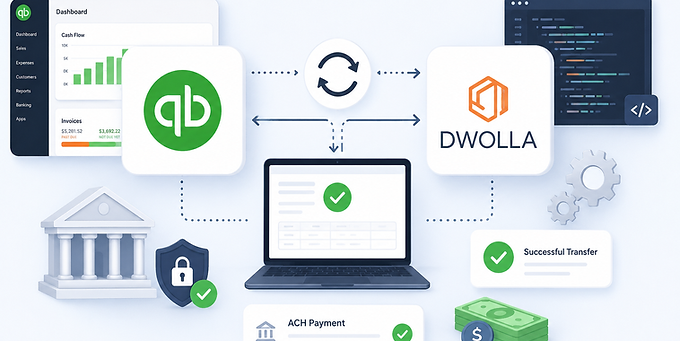
QuickBooks Dwolla Integration Services
Connect Dwolla with QuickBooks Online to automate account-to-account payment records, bookkeeping, and reconciliation.
FintegrationFS develops custom QuickBooks Dwolla Integration solutions for US fintech platforms, lenders, marketplaces, property technology companies, healthcare businesses, B2B payment providers, and financial service organizations.
Our engineers connect Dwolla transfers with the appropriate QuickBooks customers, vendors, invoices, bills, payments, deposits, and accounting records. Your team gains a clearer view of money movement without manually rebuilding every transaction inside QuickBooks.
Discuss Your Dwolla and QuickBooks Requirements
What Is QuickBooks Dwolla Integration?
QuickBooks Dwolla Integration connects Dwolla’s payment API with QuickBooks Online. It can synchronize ACH payments, customer and vendor transfers, payment statuses, returns, fees, invoices, bills, and bank deposits to automate accounting and reconciliation.
Dwolla provides API infrastructure for sending and receiving account-to-account payments through ACH and other supported payment rails. QuickBooks Online manages customers, vendors, invoices, bills, expenses, bank accounts, and financial reporting.
A custom integration creates a controlled connection between these systems. It receives Dwolla transfer information, applies your accounting rules, and creates or updates the corresponding QuickBooks records.
Why Integrate Dwolla With QuickBooks?
Dwolla may handle the actual movement of funds, while QuickBooks contains the financial obligation behind that transfer. For example, an incoming payment might relate to a customer invoice, while an outgoing payment could settle a vendor bill, borrower disbursement, insurance claim, or marketplace payout.
When the systems are disconnected, finance employees must identify each transfer, update records manually, investigate failures, and reconcile bank activity.
A reliable QuickBooks Dwolla Integration can help you:
Connect incoming transfers with customer invoices
Record outgoing transfers against vendor bills
Track pending, processed, failed, and returned payments
Record eligible transaction fees separately
Match transfers with QuickBooks bank deposits
Support collections, disbursements, and marketplace payouts
Reduce duplicate and incomplete accounting entries
Route uncertain transactions for human review
Maintain detailed synchronization logs
Improve payment and cash-flow visibility
The objective is not simply to copy transfer data. It is to ensure that QuickBooks accurately explains why money moved and which financial obligation it settled.
QuickBooks Dwolla Integration Use Cases
Customer invoice collection
A business can initiate an eligible bank payment through a Dwolla-powered application and associate it with a QuickBooks customer and invoice.
Because ACH transfers are not always completed immediately, the integration can preserve the pending status before applying the final payment according to your accounting policy.
Vendor and contractor payouts
An approved QuickBooks bill or payment request can initiate a Dwolla transfer to an eligible vendor or contractor. The resulting Dwolla transfer ID and status can be stored with the QuickBooks record for future tracking and reconciliation.
Lending and repayment workflows
Lending platforms can connect loan disbursements and borrower repayments with the appropriate QuickBooks accounts, customers, fees, and transaction records.
Marketplace payments
A marketplace can use Dwolla to move funds between participating parties while sending summarized or transaction-level accounting information to QuickBooks. Custom rules can account for platform fees, customer collections, vendor obligations, and payouts.
ACH failure and return handling
A transfer may be rejected because of insufficient funds, an invalid account, unauthorized activity, or another banking reason. Dwolla provides ACH return codes for failed transfers, allowing the integration to preserve the reason and initiate the appropriate accounting response. Dwolla explains how transfer failures and ACH return codes are handled.
How Does QuickBooks Dwolla Integration Work?
1. A payment request is created
A customer payment, vendor payout, disbursement, or repayment begins within the business application or approved QuickBooks workflow.
2. Dwolla initiates the transfer
The integration identifies the source, destination, amount, and relevant business reference before submitting the transfer through Dwolla.
3. Webhooks communicate transfer updates
ACH transfers can take time to complete. Dwolla webhooks communicate lifecycle changes so the integration can respond when a transfer becomes processed, failed, or returned. Review Dwolla’s transfer lifecycle documentation.
4. QuickBooks records are updated
The middleware creates or updates the appropriate invoice payment, bill payment, expense, deposit, transfer, journal entry, or custom tracking record.
5. Transactions are reconciled
The integration compares Dwolla transfers with QuickBooks records and bank activity. Unmatched amounts, missing references, and status conflicts enter an exception queue.
Our Dwolla and QuickBooks Integration Services
FintegrationFS provides:
Integration discovery and solution architecture
Dwolla API and webhook implementation
QuickBooks Online Accounting API integration
Customer, vendor, invoice, and bill mapping
Incoming and outgoing ACH workflows
Transfer-status and return management
Fee and clearing-account configuration
Bank-deposit reconciliation
Duplicate prevention and exception handling
Sandbox testing and production deployment
Documentation, monitoring, and ongoing support
Security and Operational Controls
A production-ready integration can include encrypted communication, protected API credentials, webhook validation, role-based access, sanitized logs, idempotency controls, secure retries, and auditable synchronization records.
QuickBooks Online uses OAuth 2.0 to authorize applications and provides sandbox companies for development and testing. Explore Intuit’s official OAuth 2.0 documentation.
Bank-account information should be collected and managed through approved interfaces rather than unnecessarily stored in QuickBooks or application logs.
Why Choose FintegrationFS?
FintegrationFS specializes in fintech API integrations, payment automation, and financial workflows. We design around real operational conditions, including asynchronous transfers, ACH returns, duplicate webhooks, reconciliation differences, and failed accounting updates.
Explore our Dwolla integration services, fintech API integration services, and fintech software development services.
Build a Reliable QuickBooks Dwolla Integration
FintegrationFS can help you plan, build, test, deploy, and maintain a secure QuickBooks Dwolla Integration aligned with your payment and accounting workflows.
Talk to Our Dwolla Integration Experts
Frequently Asked Questions
1. What is QuickBooks Dwolla Integration?
QuickBooks Dwolla Integration connects Dwolla-powered account-to-account payments with QuickBooks Online. It can synchronize transfers, invoices, bills, fees, payment statuses, returns, and reconciliation information.
2. Does QuickBooks offer a native Dwolla integration?
Standard connector availability and capabilities can vary. Businesses requiring specialized collections, disbursements, marketplace payments, custom accounting rules, or detailed reconciliation may need a purpose-built integration.
3. Can Dwolla payments update QuickBooks invoices?
Yes. An incoming Dwolla transfer can be associated with the appropriate QuickBooks customer and invoice. The integration can apply the payment when it reaches the status required by your accounting policy.
4. Can QuickBooks vendor payments initiate Dwolla transfers?
Yes. An approved bill or payout instruction can initiate a Dwolla transfer when supported by the implementation. Authorization controls should prevent unapproved employees or workflows from moving funds.
5. How are ACH returns handled in QuickBooks?
When Dwolla reports a failed or returned transfer, the integration can update or reverse the related accounting record, reopen an invoice when appropriate, preserve the return reason, and create an exception for review.
6. Can Dwolla fees be recorded separately?
Yes. Eligible Dwolla or platform fees can be assigned to designated QuickBooks expense, revenue, or clearing accounts instead of being combined with the underlying payment amount.
7. Can Dwolla transfers be reconciled automatically?
Yes. The integration can match Dwolla transfer identifiers, amounts, dates, and business references with QuickBooks transactions and bank activity. Uncertain matches can be sent to a finance employee for approval.
8. How much does QuickBooks Dwolla Integration cost?
Cost depends on payment flows, transfer volume, number of QuickBooks companies, customer and vendor workflows, accounting rules, approval requirements, return handling, historical migration, and reconciliation complexity. A technical discovery provides the most dependable estimate.