The Indian SEBI RIA and RA Advisory Tech Landscape: Your Options in 2026


The Framework: Should Your Firm Build Custom?
Not every advisory firm needs a custom platform. Here’s the honest framework we use with our own prospects:
Build custom if:
Your brand equity is a significant competitive advantage that gets diluted on a marketplace.
You have (or plan to build) proprietary capabilities — AI engines, unique risk profiling, content strategies — that can’t be implemented within a third-party platform’s constraints.
Your subscription revenue at scale makes the marketplace’s 10–20% take-rate economically painful.
You need deep integration with existing internal systems (CRM, research databases, portfolio management tools).
You view the platform as a long-term strategic asset, not just a distribution channel.
Use a marketplace or SaaS if:
You’re in the first 1–2 years of your advisory business and need distribution more than brand control.
Your investment philosophy doesn’t require a differentiated user experience to convey.
You don’t have (or want) a dedicated product and engineering budget.
Speed to market matters more than long-term platform ownership.
Your subscriber base is small enough that the marketplace take-rate is a reasonable cost of distribution.
Renaissance fell clearly into the “build custom” category: 28 years of brand equity, a proprietary investment philosophy that is the product, plans for AI-powered recommendation engines, and an existing CRM with years of client data. The custom path gave them full ownership of the client relationship, 100% of subscription economics, and an independent product roadmap.
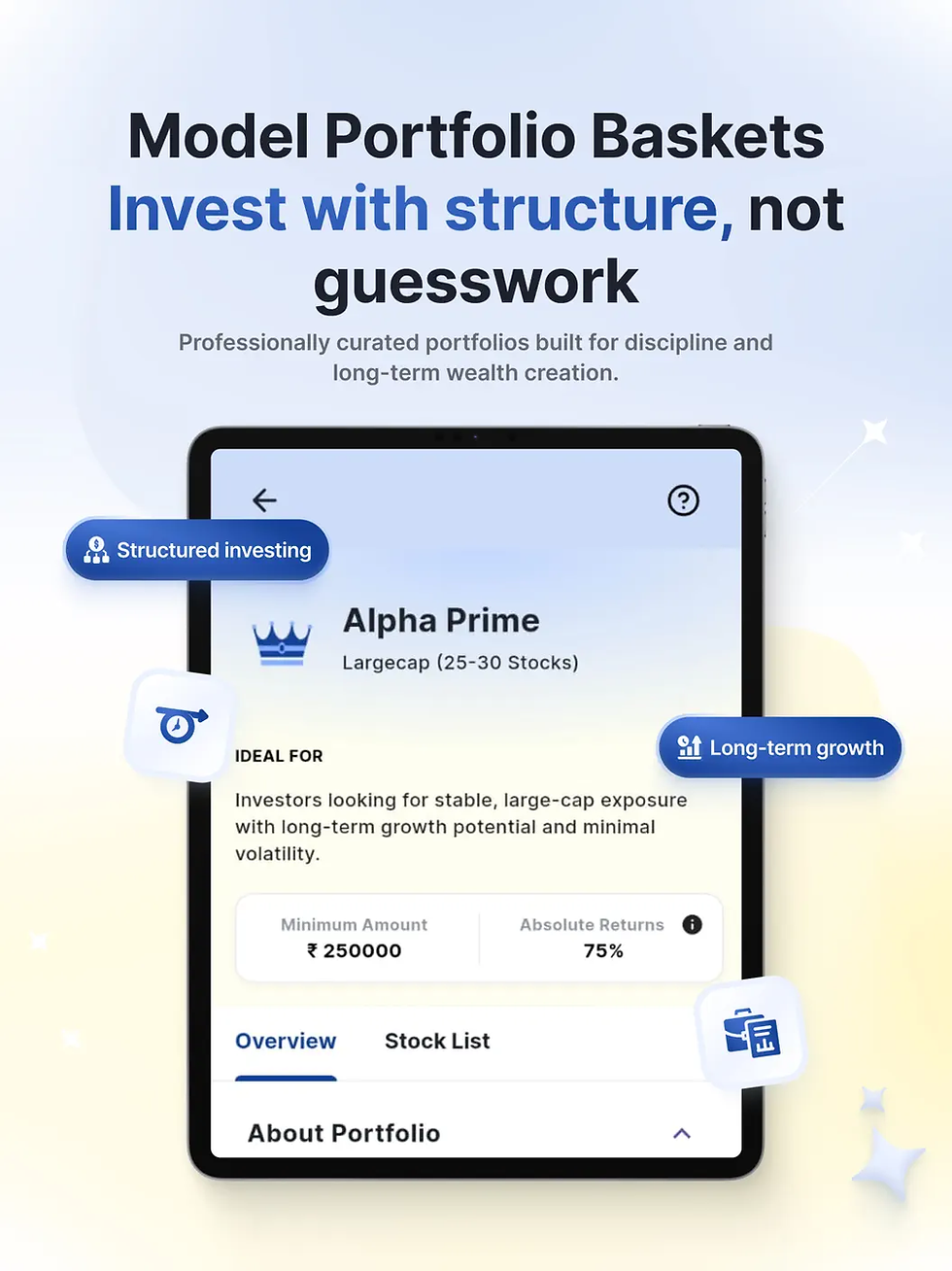
Before we get into what we built, let’s map the territory. If you’re a SEBI-registered RA or RIA looking to distribute model portfolios digitally, you have four paths:
Path 1: Marketplace (Smallcase, WealthDesk)
You get access to millions of investors and built-in broker integrations. The platform handles compliance workflows, payment processing, and trade execution. You focus on research and portfolio construction. The trade-off: 10–20% revenue share, no brand control, no client data ownership, and your portfolio competes for attention alongside 250+ other offerings. Your product roadmap is constrained by the platform’s feature set.
Path 2: B2B SaaS (AlphaQuark)
Purpose-built for SEBI RAs. You get model portfolio management, compliance automation, multi-broker execution, and sometimes a white-label app. More control than a marketplace, lower cost than custom. The trade-off: your UX is shaped by their templates, your features are limited to their roadmap, and deep customization (proprietary risk profiling, AI engines, CRM integration with legacy systems) usually isn’t possible.
Path 3: PaaS Infrastructure
API-first infrastructure layer. You build your own frontend on their rails — they handle KYC, e-sign, OMS integration, compliance, and payment processing as APIs. More flexibility than SaaS, less build effort than fully custom. The trade-off: you’re still constrained by their data models and integration capabilities. If their OMS integration doesn’t support your broker, or their compliance workflow doesn’t match your process, you’re stuck. These are typically early-stage companies, which introduces platform risk.
Path 4: Fully Custom (What We Built)
You own everything: the client relationship, the data, the economics, the brand experience, the product roadmap. No revenue share. No platform dependency. No feature constraints. The trade-off: higher upfront investment, longer time-to-market, and you need an engineering partner who understands fintech regulation, not just mobile app development.
For the Renaissance, Path 4 was the right choice. For your firm, it might not be. We’ll give you a framework for deciding at the end of this article. But first, here’s what building Path 4 actually involved.

Five Hard Problems We Solved (And What We’d Tell You About Each)
1. SEBI Compliance Is an Architecture Decision, Not a Checklist
This is the single most misunderstood aspect of building advisory platforms. Most firms treat compliance as a layer you add after the product is built — bolt on KYC here, add an audit trail there, generate a SEBI report quarterly. That approach creates technical debt that compounds with every regulatory change.
We built compliance into the architecture from day zero. PAN validation via CVL KRA happens during onboarding, not after. E-sign workflows are embedded in the subscription journey. Every user action writes to immutable audit tables that are automatically indexed for regulatory queries. KYC documents are encrypted at rest and retained for seven years per SEBI/RBI guidelines with role-based access control.
The result: when SEBI’s compliance team asks for records, the system generates them in minutes, not days. When regulations change (as they did with the 2024 model portfolio guidelines and the 2025 structured UPI mandates), the platform adapts at the infrastructure layer without disrupting the user experience.
What we’d tell you: If your current platform treats compliance as an afterthought, every regulatory update will feel like a fire drill. If you’re building new, get this right first.
2. Onboarding Is Where You Win or Lose the Business
The journey from “interested investor” to “paying subscriber with an executed portfolio” involves at least seven steps: mobile verification, email confirmation, risk profiling, KYC documentation, advisory agreement e-sign, payment processing, and broker authentication. The industry average dropout rate for fintech onboarding flows this complex is 70–80%.
We used durable workflow orchestration to make this survivable. If a user completes risk profiling but drops off before KYC, the system remembers exactly where they stopped. When they return — hours or days later, on a different device — they resume from exactly that point. No repeated steps, no lost data. The workflow engine handles retries automatically when third-party services have intermittent failures.
We also designed the risk profiling step to do double duty: it’s not just a compliance requirement, it’s a personalization engine. The user’s risk profile determines which model portfolios are recommended, creating an immediate sense that the platform understands them. This turns a compliance gate into a value moment.
What we’d tell you: Don’t think of onboarding as a form to fill out. Think of it as the first 90 seconds of a relationship. Every step that feels like friction is a user you’ll never see again.
3. Mobile & Web Is Production-Ready for Fintech
AdvisorAlpha runs on iOS, Android, and Flutter Web from a single codebase. The mobile deployments were straightforward. The web deployment was where we earned our fee.
Flutter Web’s ecosystem for financial applications has significant gaps. Payment gateway SDKs, broker authentication libraries, and biometric/PIN authentication — all of which have mature Flutter mobile plugins — have no web equivalents. If you try to ship a fintech Flutter Web app without solving this, you get a browser experience that’s visibly inferior to mobile.
We engineered custom JavaScript interop bridges that maintain full feature parity across platforms. The payment checkout flow works identically on web and mobile. Broker authentication works in the browser. Platform-specific edge cases are handled at the bridge layer, keeping the application codebase unified.
What we’d tell you: Flutter Web is absolutely viable for fintech in 2026, but only if your engineering team knows where the gaps are and has built bridges before. If your partner says “Flutter Web is easy, it’s the same codebase,” find a different partner.
4. Middleware Is Where Most Fintech Platforms Quietly Fail
At Fintegration, we place a disproportionate emphasis on middleware — the connective tissue between services, third-party integrations, and legacy systems. This is consistently where we see the biggest gap between platforms that work and platforms that work reliably.
When a user pays for a subscription, the system needs to simultaneously activate portfolio access, send confirmations across multiple channels, update the CRM, log the transaction for compliance, and fire analytics events. If any of these fail — and in production, something always fails — the question is whether the failure cascades or is contained.
We used event-driven architecture to decouple services and durable workflow orchestration for stateful processes that must complete reliably. Renaissance also had an existing CRM with years of client data in a legacy database. We didn’t rip and replace — we built middleware that integrates with their existing system while extending it with modern capabilities. This is a common challenge for established advisory firms: they can’t start from zero, but they need modern capabilities on top of legacy infrastructure.
What we’d tell you: Ask your engineering partner about their middleware philosophy. If they don’t have one, your platform will work beautifully in demos and break unpredictably in production.
5. Growth Engineering Isn’t Optional for Advisory Platforms
Building the platform is the beginning, not the end. The harder challenge is turning it into a growing business. Advisory platforms don’t grow on product quality alone — they grow on understanding which users convert, why others don’t, and what keeps subscribers engaged between rebalancing cycles.
We integrated a full growth engineering stack: product analytics for funnel tracking, behavioral engagement automation for personalized communication, deep linking for attribution-aware marketing campaigns, and multi-channel notification orchestration for critical alerts.
The critical nuance is that growth tooling in fintech must be compliance-aware. Push notifications can’t contain specific investment advice. Marketing automation must carry SEBI disclaimers. User segmentation must respect KYC data privacy. We built the integration layer to enforce these constraints automatically, so the marketing team can move fast without accidentally triggering a compliance violation.
What We Build at Fintegration
Fintegration is a fintech product engineering firm. We’ve spent over a decade building digital platforms for financial services companies — investment advisory apps, portfolio management systems, regulatory-compliant onboarding flows, and broker-integrated trading platforms.
We’re particularly known for three things: our middleware-first architecture philosophy (because this is where most fintech platforms fail quietly), our Flutter expertise across all three platforms including web (because this is where most development shops give up), and our deep understanding of SEBI/RBI compliance requirements (because this is what separates fintech development from generic app development).
If you’re a SEBI-registered Research Analyst or Investment Advisor evaluating whether to build your own platform, we’re happy to walk you through the decision framework in more detail. No pitch deck required — just a conversation about your specific situation.


